A Kick in the Fundament for Felon-in-Possession?
Key Takeaways
- The Supreme Court has NOT struck down 18 U.S.C. § 922(g)(1); the federal felon-in-possession ban remains enforceable.
- Wolford v. Lopez (June 25, 2026) reinforced that the Second Amendment protects a 'fundamental right of self-defense.'
- United States v. Hemani (June 18, 2026) struck down § 922(g)(3) but expressly declined to address § 922(g)(1).
- Justice Alito, joined by Justice Kagan, confirmed that Hemani does not cast doubt on 'presumptively lawful' felon prohibitions.
- The strongest future challenges will be as-applied challenges based on old, nonviolent, non-firearm convictions.
- Vincent v. Bondi raised the nonviolent-felon question but certiorari was denied on March 2, 2026.
- Anyone with a qualifying conviction should not possess firearms or ammunition without confirming legal eligibility with counsel.
Reading Is Fundamental. So Is Getting § 922(g)(1) Right.
The word "fundamental" has been doing a lot of constitutional work lately.
It is also a word with an odd little history. Its root, "fundament," can refer to the body's less dignified rear section. That may have been hilarious in seventh grade, but in constitutional law, "fundamental" is not a joke. When the Supreme Court uses that word repeatedly, lawyers should pay attention.
That is why the Court's recent Second Amendment decisions matter for people watching the future of the federal felon-in-possession statute, 18 U.S.C. § 922(g)(1).
To be clear, the Supreme Court has not struck down § 922(g)(1). The federal ban remains enforceable. A person with a qualifying conviction should not treat the Court's recent cases as permission to possess a firearm or ammunition.
But the Court's language is creating tension. If the Second Amendment protects a fundamental right, can the government permanently take that right away from every person with a qualifying felony conviction, including people whose convictions were old, nonviolent, and unrelated to firearms?
That question is not going away.
The Supreme Court has not invalidated the felon-in-possession statute. But its recent Second Amendment language makes categorical, lifetime disarmament harder to defend in every case.
The Statute Still Means What It Says
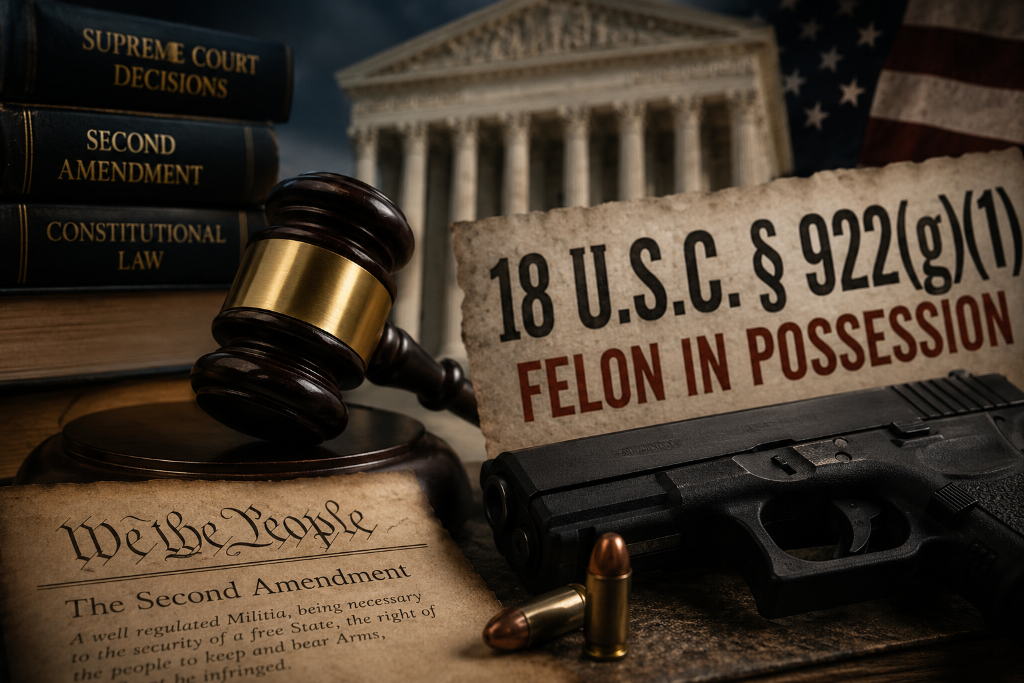
Section 922(g)(1) makes it unlawful for a person convicted of a crime punishable by more than one year in prison to possess, receive, ship, or transport firearms or ammunition in or affecting interstate commerce. The penalty provision, 18 U.S.C. § 924(a)(8), authorizes up to 15 years in prison for knowingly violating § 922(g).
There are statutory limits. Under 18 U.S.C. § 921(a)(20), certain convictions do not count if they have been expunged, set aside, pardoned, or followed by restoration of civil rights, unless the relief expressly preserves a firearms restriction. That is why restoration language matters so much in federal firearms cases.
So the practical rule remains simple: unless the conviction no longer qualifies under federal law, § 922(g)(1) remains a serious federal criminal statute.
The constitutional question is different.
What Wolford Changed — And What It Did Not
In Wolford v. Lopez, the Supreme Court struck down Hawaii's rule prohibiting licensed concealed-carry permit holders from carrying handguns onto private property open to the public unless the property owner gave express authorization. The Court held that Hawaii's rule violated the Second and Fourteenth Amendments.
That holding does not involve felons. It does not involve § 922(g)(1). It does not give anyone with a felony conviction the right to possess a firearm.
But the Court's reasoning matters.
The Court described the Second Amendment as protecting the "fundamental right of self-defense" and emphasized that local attitudes cannot change the meaning of fundamental Bill of Rights protections.
That language creates pressure. Courts do not usually treat fundamental rights as things the government may permanently erase by category, without asking whether the restriction is historically justified as applied to the person in front of the court.
That is the problem for lifetime felon disarmament.
Hemani Adds Fuel, But Also Draws a Line
One week before Wolford, the Court decided United States v. Hemani, a challenge to § 922(g)(3), the federal statute barring firearm possession by unlawful users of controlled substances.
The Court held that the government could not constitutionally prosecute Hemani under § 922(g)(3) on the theory that regular marijuana use automatically made him categorically dangerous. The Court was skeptical of giving the government broad power to label an entire group dangerous and then disarm that group.
That reasoning sounds helpful to future § 922(g)(1) challenges.
But Hemani also contains a warning label. The Court said its decision was narrow and expressly stated that it was not addressing § 922(g)(1), the provision disarming people convicted of felonies.
The Court also noted that § 922(g)(1) differs from § 922(g)(3) because a felony conviction involves some form of pre-deprivation process before firearm rights are lost. Justice Alito, joined by Justice Kagan, was even more explicit that nothing in Hemani should be read to cast doubt on § 922(g)(1) or the "presumptively lawful" prohibitions on firearm possession by felons and the mentally ill.
So Hemani is not a get-out-of-§922(g)(1)-free card.
It is something more subtle: another sign that the Court is uncomfortable with broad categorical disarmament when the historical fit is weak.
The Real Battleground: Nonviolent Felonies
The strongest constitutional challenges to § 922(g)(1) are not likely to come from people with recent violent convictions, firearm-related convictions, or records showing present dangerousness.
The harder cases involve people with old, nonviolent convictions: financial crimes, regulatory offenses, drug offenses without violence, failure-to-pay offenses, or other conduct that does not obviously show a person is dangerous with a firearm.
That is where the constitutional tension becomes sharp.
If the Second Amendment protects a fundamental right, the government must explain why a person permanently loses that right because of a conviction that may have had nothing to do with violence, weapons, or public safety.
The government's answer is familiar: Heller, McDonald, Bruen, Rahimi, Wolford, and Hemani all leave room for longstanding prohibitions on firearm possession by felons.
The challengers' answer is just as familiar: "presumptively lawful" does not mean "automatically lawful forever, in every case, for every person."
Both arguments are now live in the lower courts.
The Supreme Court Has Been Offered the Question
This is not an academic issue. The Supreme Court has already had vehicles to address it.
In Vincent v. Bondi, the petitioner asked whether the Second Amendment allows the government to permanently disarm a person with a years-old nonviolent felony conviction. The petition was distributed for multiple conferences before the Court denied certiorari on March 2, 2026.
That denial does not decide the issue. It only means the Court declined to take that case at that time.
But with Wolford emphasizing the fundamental nature of the right and Hemani pushing back against unsupported categorical disarmament, another case is almost certainly coming.
Practical Takeaway
For now, § 922(g)(1) remains federal law. A person with a qualifying conviction should not possess firearms or ammunition unless counsel has confirmed that the conviction no longer counts under federal law or that firearm rights have been restored in a way federal law recognizes.
But for litigators, the path is becoming clearer.
The most viable future challenges will likely be as-applied challenges involving old, nonviolent, non-firearm convictions, strong evidence of rehabilitation, and no individualized evidence of dangerousness.
That does not mean those challenges will win. It means they are no longer fringe arguments.
The Supreme Court keeps saying the Second Amendment protects a fundamental right. It also keeps saying felon prohibitions are presumptively lawful.
Eventually, the Court will have to explain how both statements apply to the person whose only disqualifying conviction is old, nonviolent, and unrelated to firearms.
Until then, § 922(g)(1) remains standing.
But the kicking has begun.
Key Authorities
Wolford v. Lopez, No. 24-1046, 609 U.S. ___, 2026 U.S. LEXIS 2720 (June 25, 2026) United States v. Hemani, No. 24-1234, 608 U.S. ___, 2026 U.S. LEXIS 2559 (June 18, 2026) District of Columbia v. Heller, 554 U.S. 570 (2008) New York State Rifle & Pistol Ass'n v. Bruen, 597 U.S. 1 (2022) United States v. Rahimi, 602 U.S. 680 (2024) Rehaif v. United States, 588 U.S. 225 (2019) Caron v. United States, 524 U.S. 308 (1998) 18 U.S.C. §§ 921(a)(20), 922(g)(1), 922(g)(3), 924(a)(8), 924(e)
Disclaimer: This article provides general legal information for educational purposes only. It is not legal advice and does not create an attorney-client relationship. Always consult a licensed attorney for advice regarding your specific legal situation.
Michael Alcocer
Michael Alcocer writes about legal topics in plain English, helping readers understand criminal justice, court procedure, sentencing, appeals, and civil rights.