Birthright Citizenship Survives: The Supreme Court Rejects Trump's 14th Amendment Theory
Key Takeaways
- The Supreme Court ruled 5-4 on June 30, 2026 that children born in the U.S. to undocumented or temporarily present parents are citizens under the Fourteenth Amendment.
- President Trump's Executive Order No. 14160 was struck down for attempting to add conditions not found in the Constitution's Citizenship Clause.
- The Court reaffirmed United States v. Wong Kim Ark (1898) as the controlling precedent on birthright citizenship.
- The majority held that the phrase 'subject to the jurisdiction' does not exclude children of undocumented or temporary-visa parents.
- Justice Kavanaugh concurred in the result on statutory grounds but did not join the constitutional holding.
- The ruling does not affect immigration enforcement or the prosecution of birth tourism fraud schemes.
- Citizenship status and criminal exposure for adults who commit fraud remain separate legal questions.
The Supreme Court's Decision in Trump v. Barbara
The Supreme Court's decision in Trump v. Barbara is not simply an immigration ruling. It is a constitutional ruling about who belongs to the American political community, who gets to define citizenship, and whether a president can narrow a constitutional guarantee by executive order.
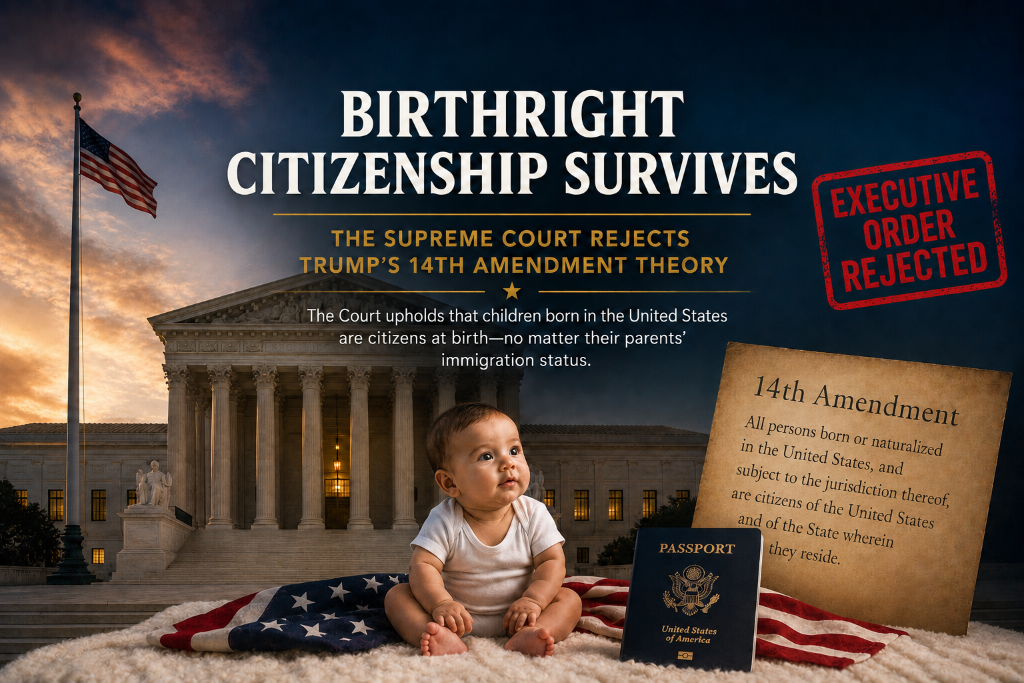
On June 30, 2026, the Court rejected President Donald Trump's attempt to limit birthright citizenship for children born in the United States to parents who are unlawfully or temporarily present in the country. The Court held that those children are "subject to the jurisdiction" of the United States and are citizens at birth under the Fourteenth Amendment's Citizenship Clause.
That holding preserves the traditional understanding of American birthright citizenship: with narrow historical exceptions, a child born on U.S. soil is a U.S. citizen.
The Citizenship Clause Still Means What It Says
Birthright citizenship is often described by the Latin phrase jus soli, meaning "right of the soil." The principle is straightforward: citizenship is acquired by place of birth, not by bloodline, ancestry, or parental immigration status.
In the United States, that rule comes from the Fourteenth Amendment, ratified in 1868 after the Civil War. Its Citizenship Clause provides that:
"All persons born or naturalized in the United States and subject to the jurisdiction thereof, are citizens of the United States and of the State wherein they reside."
The clause was adopted in the shadow of Dred Scott v. Sandford, the infamous 1857 decision that denied citizenship to Black Americans. In Trump v. Barbara, Chief Justice John Roberts placed the Citizenship Clause in that Reconstruction context, explaining that the Fourteenth Amendment repudiated a view of citizenship based on inherited status and restored the broader common-law principle of citizenship by birth.
That history matters. The Citizenship Clause was designed to prevent political branches from manipulating citizenship to exclude disfavored groups. Its purpose was not merely administrative. It was structural.
It answered a foundational question: who is a citizen?
What Trump's Executive Order Tried to Do
President Trump's Executive Order No. 14160, titled "Protecting the Meaning and Value of American Citizenship," attempted to create two new exceptions to birthright citizenship.
The order said that U.S. citizenship would not automatically extend to a child born in the United States if the child's mother was unlawfully present and the father was not a U.S. citizen or lawful permanent resident. It also applied to children whose mothers were lawfully but temporarily present — such as on certain student, work, or tourist visas — if the father was not a citizen or lawful permanent resident.
In practical terms, the order would have directed federal agencies not to recognize certain U.S.-born children as citizens. That would have affected passports, Social Security documentation, immigration status, and access to programs that depend on citizenship.
The administration's legal theory turned on the phrase "subject to the jurisdiction" of the United States. It argued that children of undocumented immigrants and temporary visitors were not fully subject to U.S. jurisdiction in the constitutional sense because their parents retained allegiance to a foreign sovereign.
The Court rejected that theory.
Why the Executive Order Failed
The majority opinion did not treat "subject to the jurisdiction" as an open-ended invitation for the executive branch to redefine citizenship. Instead, it read the phrase in light of English common law, early American legal tradition, Reconstruction history, and the Supreme Court's 1898 decision in United States v. Wong Kim Ark.
The Court emphasized that a child born in the United States and subject to American law satisfies the two textual requirements of the Citizenship Clause: birth in the United States and subjection to U.S. jurisdiction. The historically recognized exceptions are narrow — including children of foreign diplomats and children born in territory under hostile occupation. Children of parents who are unlawfully or temporarily present do not fall within those exceptions.
One of the most direct lines in the opinion concerned the executive order's own language. The Court noted that words central to the order — "mother," "father," "lawful," and "temporary" — do not appear in the Citizenship Clause.
That point captures the heart of the ruling. The Constitution does not condition birthright citizenship on the immigration status of a child's parents. Nor does it give the president authority to add such a condition.
The Vote Was More Nuanced Than the Headline
The judgment was a defeat for the executive order, but the Court's alignment was more nuanced than a simple headline suggests.
Chief Justice Roberts wrote the opinion of the Court. Justices Sonia Sotomayor, Elena Kagan, Amy Coney Barrett, and Ketanji Brown Jackson joined that constitutional opinion. Justice Brett Kavanaugh concurred in the judgment but dissented from the Court's constitutional reasoning. Justices Clarence Thomas, Neil Gorsuch, and Samuel Alito dissented.
That means five justices concluded that the Fourteenth Amendment itself protects birthright citizenship for the children covered by the executive order. Justice Kavanaugh agreed that the order could not stand, but he reached that result on statutory grounds. In his view, the order conflicted with 8 U.S.C. § 1401(a), the federal statute codifying birthright citizenship, even though he believed Congress could potentially amend the statute to create new exceptions.
That distinction matters. The controlling constitutional opinion makes it difficult for Congress to restrict birthright citizenship by ordinary legislation. Kavanaugh's separate opinion suggests a statutory path, but that was not the majority's view.
Wong Kim Ark Remains the Anchor
The decision reaffirms the continuing force of United States v. Wong Kim Ark, the 1898 case that has long served as the central precedent on birthright citizenship.
Wong Kim Ark was born in San Francisco to Chinese parents who were not U.S. citizens. After traveling abroad, he was denied reentry on the theory that he was not a citizen. The Supreme Court held that he was a citizen under the Fourteenth Amendment.
The Trump administration tried to narrow Wong Kim Ark by emphasizing that Wong's parents were domiciled in the United States. The majority in Trump v. Barbara rejected that reading, concluding that the reasoning of Wong Kim Ark was not limited to children of permanently domiciled parents. The Court read the case as confirming the broader common-law rule: those born on U.S. soil and subject to U.S. law are citizens at birth, except for narrow historical categories.
The dissenters saw the issue differently. Justice Thomas argued that the Citizenship Clause should be read to require domicile and complete political allegiance. Justice Alito likewise rejected the majority's broad interpretation. But those views did not control the judgment.
What the Decision Does Not Do
The ruling does not eliminate the federal government's authority to enforce immigration law. It does not prevent prosecution of immigration fraud. It does not give legal status to undocumented parents. And it does not prevent Congress or federal agencies from addressing specific misconduct connected to so-called birth tourism.
That distinction is already becoming important. After the decision, the Justice Department reportedly directed federal prosecutors to prioritize investigations of birth tourism schemes, including possible charges involving visa fraud, money laundering, identity theft, and wire fraud.
That is where the federal criminal law issue now moves. The government cannot deny citizenship to a child who is constitutionally entitled to it. But it may still investigate and prosecute adults who allegedly entered the country through fraud or participated in fraudulent schemes.
In other words, citizenship status and criminal exposure are separate questions. The child's citizenship is protected by the Constitution. Alleged fraud by adults remains subject to ordinary criminal enforcement.
Is the United States Alone?
No. The United States is not the only country with birthright citizenship. But unrestricted U.S.-style birthright citizenship is not the global norm.
A 2026 Pew Research Center analysis found that 32 other countries have birthright citizenship laws substantially similar to the United States, most of them in the Western Hemisphere. Pew also identified roughly 50 additional countries with more limited forms of birthright citizenship.
That global comparison is useful, but it does not answer the American constitutional question. The U.S. rule is rooted in the Fourteenth Amendment. Whatever other countries choose to do, the American issue turns on constitutional text, history, precedent, and the separation of powers.
Why This Ruling Matters
The most important part of Trump v. Barbara is not only that birthright citizenship survived. It is that the Court rejected the idea that citizenship can be narrowed by unilateral executive action.
That principle has consequences beyond immigration. Citizenship is the legal foundation for political membership. It determines who has an unconditional right to remain in the country, who can claim the full protection of the Constitution, and who belongs to the constitutional community.
Near the end of the opinion, Chief Justice Roberts described citizenship as "the right to have rights" and wrote that the framers of the Fourteenth Amendment extended that promise broadly. The Court concluded: "We keep that promise today."
That is the deeper meaning of the decision. The president may set enforcement priorities. Agencies may administer immigration law. Congress may legislate within constitutional bounds. But the executive branch cannot rewrite the Citizenship Clause.
For now, the rule remains clear: a child born in the United States is a citizen at birth, even if that child's parents are undocumented or only temporarily present, unless the child falls within one of the narrow historical exceptions recognized by the Constitution.
Birthright citizenship survived because the Court treated citizenship as a constitutional status, not a policy preference.
Disclaimer: This article provides general legal information for educational purposes only. It is not legal advice and does not create an attorney-client relationship. Always consult a licensed attorney for advice regarding your specific legal situation.
Michael Alcocer
Michael Alcocer writes about legal topics in plain English, helping readers understand criminal justice, court procedure, sentencing, appeals, and civil rights.