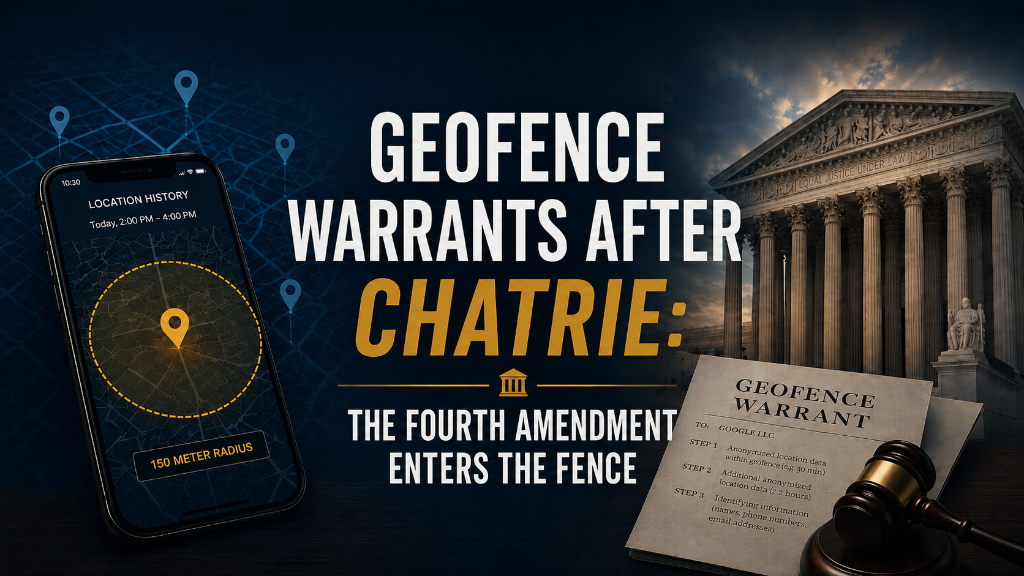
Geofence Warrants After Chatrie: The Fourth Amendment Enters the Fence
Key Takeaways
- The Supreme Court held that police conducted a Fourth Amendment search when they obtained Chatrie's Google Location History data.
- The decision builds on Carpenter v. United States, which protected historical cell-site location information.
- Google Location History may be more precise than CSLI because it can record location every two minutes and estimate location within about 20 meters.
- The Court rejected the government's argument that Chatrie lost Fourth Amendment protection because the data was held by Google.
- The Court also rejected the idea that two hours of location data was too short to trigger Fourth Amendment protection.
- The Court did not decide whether the geofence warrant was supported by probable cause or described with particularity.
- Justice Jackson would have gone further and found the warrant invalid, especially at steps two and three.
- Justice Gorsuch agreed that a search occurred, but relied on a property-rights theory.
- The strongest future challenges will focus on geofence size, time window, scope, officer discretion, judicial supervision, probable cause, particularity, and good faith.
The Supreme Court has now placed geofence warrants squarely inside the Fourth Amendment.
In Chatrie v. United States, the Court held that police conduct a Fourth Amendment "search" when they obtain a person's Google Location History data through a geofence warrant. That is an important ruling for digital privacy, criminal investigations, and suppression litigation.
But the decision is also narrower than some headlines suggest.
The Court did not hold that every geofence warrant is unconstitutional. It did not decide that every defendant whose case involves geofence evidence is entitled to suppression. And it did not give law enforcement a blank check to use reverse-location searches so long as they call the request a warrant.
Instead, Chatrie answers the first question: obtaining this kind of location-history data is a search. The harder questions—probable cause, particularity, overbreadth, and good faith—remain for the lower courts.
A geofence warrant is a search. That changes the starting point for future suppression litigation.
What Is a Geofence Warrant?
A geofence warrant reverses the usual investigative process.
In a traditional search, the government normally starts with a person, a phone, a home, a car, or an account. The warrant identifies the target and seeks evidence connected to that target.
A geofence warrant starts with a location.
Law enforcement draws a virtual boundary around a place where a crime occurred—such as a bank, store, street corner, or residence—and identifies a specific time period. The government then asks a technology company to search its location database and identify devices that were inside that area during that time.
That can be useful to investigators when they do not yet know who committed the crime.
It can also be dangerous.
A geofence search may identify a suspect, but it can also sweep in people who had nothing to do with the offense: customers, employees, delivery drivers, neighbors, patients, worshippers, journalists, protestors, or anyone else whose phone happened to be nearby.
A geofence around a bank may capture customers, employees, delivery drivers, nearby residents, or people passing through. A geofence around a church, clinic, protest, defense attorney's office, hospital, school, or private residence raises even more serious privacy concerns.
That is the constitutional problem.
A tool designed to find one suspect may begin by searching many people.
The Facts Behind Chatrie
The case began with a 2019 credit union robbery in Midlothian, Virginia.
Police learned from witnesses and surveillance footage that the robber approached the credit union from the corner of a nearby church while appearing to talk on a cellphone. Investigators did not have a suspect, so they sought a geofence warrant directed to Google.
The warrant required Google to search Location History data for devices located within a 150-meter radius of the credit union during the time surrounding the robbery.
Google's production occurred in stages.
First, Google provided anonymized location data for devices inside the geofence. Then officers narrowed the list and obtained additional location data for selected users. Finally, officers narrowed the list again and obtained identifying information for three users.
One of those users was Okello Chatrie.
The location data placed Chatrie inside the geofence about ten minutes before the robbery and showed him moving toward a residential area after leaving the bank. After further investigation, federal prosecutors charged him with robbery and related firearm offenses.
Chatrie moved to suppress the evidence. He argued that the government had conducted a Fourth Amendment search and that the warrant was invalid because it resembled a modern general warrant: a broad search through private information first, followed by suspect identification later.
The district court agreed that the warrant violated the Fourth Amendment, but admitted the evidence under the good-faith exception. The Fourth Circuit later split over whether obtaining the data was a search at all.
The Supreme Court has now resolved that threshold issue.
The Supreme Court's Holding
Writing for the Court, Justice Kagan concluded that a person has a reasonable expectation of privacy in cellphone location records. Police intrude on that privacy interest when they demand that information from a technology company, even if the request covers only a limited time period.
The Court's reasoning builds on Carpenter v. United States, where the Supreme Court held that historical cell-site location information is protected by the Fourth Amendment.
The principle is straightforward: cellphone location data can reveal far more than a person's general whereabouts. It can expose movements, routines, associations, private visits, political activity, medical appointments, religious attendance, and other sensitive details of daily life.
Google Location History may be even more precise than the cell-site records at issue in Carpenter. Location History can record a phone's location every two minutes or so, identify location within about 20 meters, and sometimes estimate elevation within a building. The fact that the information is stored by Google does not remove it from constitutional protection.
Justice Gorsuch agreed that Chatrie should prevail on the search question, but he reached that conclusion through a different path. In his view, Chatrie's Location History data qualified as personal property protected by the Fourth Amendment.
Either way, six Justices agreed on the key point: when the government obtains this kind of location-history data, it conducts a search.
Why Carpenter Controlled the Analysis
The decision builds directly on Carpenter v. United States.
In Carpenter, the Supreme Court held that the government conducts a Fourth Amendment search when it obtains historical cell-site location information from a wireless carrier. The reason was that cellphone location records can create a detailed record of a person's movements.
Chatrie extends that logic to Google Location History.
The Court explained that Location History may be even more revealing than the cell-site records at issue in Carpenter. Location History can record a phone's location every two minutes or so, identify location within about 20 meters, and sometimes estimate elevation within a building.
That level of precision matters.
Location data can reveal more than where someone was standing. It can reveal patterns, associations, habits, private visits, and sensitive locations. It can show whether someone went to a doctor, a school, a residence, a political meeting, a place of worship, or a lawyer's office.
The government's access to that information is not made harmless just because the data is digital.
Nor is it made harmless because the government asks Google for the information instead of taking it directly from the phone.
The Third-Party Doctrine Did Not Save the Government
The government also relied on the third-party doctrine.
Under older cases like United States v. Miller and Smith v. Maryland, a person generally has reduced Fourth Amendment protection in certain information voluntarily conveyed to a third party, such as bank records or dialed phone numbers.
But Carpenter already limited that doctrine in the context of cell-site location information. Chatrie applies the same principle to Google Location History.
The Court refused to treat Location History as an ordinary business record. It reasoned that modern cellphone use is not meaningfully comparable to voluntarily handing over a limited piece of information to a bank or telephone company.
That is especially true where Google prompts users to activate Location History, where users may not understand the frequency or precision of the tracking, and where the service runs in the background.
The larger point is important:
A person does not lose all Fourth Amendment protection simply by using ordinary smartphone services.
That is one of the most significant parts of Chatrie. The decision narrows the government's ability to rely on the third-party doctrine in digital-location cases.
Two Hours Was Enough
The government also argued that the search involved only two hours of location data and therefore did not implicate the Fourth Amendment.
The Court rejected that argument too.
The Fourth Amendment does not begin only after the government has collected enough information to make the intrusion severe. If the government accesses a constitutionally protected category of information, the search occurs when the government obtains it.
That is especially true with Location History because even a short time window can reveal sensitive information. A two-hour period may show a person entering a private home, hospital, school, church, political event, criminal defense office, or other revealing location.
The Court also recognized the retrospective nature of the technology. The government does not need to decide in advance whom to watch. It can go back later, pick a place and time, and ask the database who was there.
That is what makes geofence warrants different from ordinary visual surveillance.
The government is not just watching a public street. It is querying a historical database of people's movements.
What Chatrie Does Not Decide
The ruling does not end the geofence debate.
The Court did not decide whether the warrant in Chatrie's case satisfied the Fourth Amendment's requirements of probable cause and particularity. That issue was left for the Fourth Circuit on remand.
That distinction is critical.
A search can be constitutional if it is supported by a valid warrant. But a warrant still must be narrow enough, specific enough, and supported by probable cause. In geofence cases, those questions can be difficult.
How large was the geofence?
How long was the time window?
How many innocent people were swept into the search?
Did the warrant give officers too much discretion to decide which anonymous users would later be identified?
Did police return to a judge before expanding the search or obtaining names?
Those details will matter.
Justice Jackson's Concurrence
Justice Jackson, joined by Justice Sotomayor, would have gone further.
She agreed that the government conducted a search, but she also would have held that the search violated the Fourth Amendment.
Her focus was on steps two and three of the warrant process. At those stages, officers obtained additional location data and identifying information after narrowing the list themselves.
The problem, in Justice Jackson's view, was that the warrant did not provide clear narrowing criteria and did not require officers to return to a magistrate before expanding the search.
That created a familiar Fourth Amendment concern: too much discretion in the hands of the officers executing the warrant.
Her concurrence matters because it previews the likely future litigation over geofence warrants. The next fight will not simply be whether a search occurred. After Chatrie, that question is answered.
The next fight will be whether the warrant was narrow enough and whether a judge, rather than police officers, controlled the meaningful decisions.
Justice Gorsuch's Property Theory
Justice Gorsuch agreed that the government conducted a search, but he did not rely on the reasonable-expectation-of-privacy framework.
He would have resolved the case under a property-based theory.
In his view, Chatrie's Location History data qualified as his personal property. He emphasized that Google treated the data as the user's information, that the user could access, edit, export, or delete it, and that Google promised to protect it.
That theory matters because it may shape future Fourth Amendment arguments involving digital data stored by third parties.
The government often argues that data held by a company belongs to the company, not the user. Justice Gorsuch's concurrence pushes in the opposite direction. Digital records may still be the user's "effects," even if stored on a company's servers.
That argument may become more important in future cases involving cloud storage, email, photos, calendars, search histories, app data, and other digital records.
The Dissents
Justice Alito dissented, joined in part by Justices Thomas and Barrett. Justice Barrett also wrote separately.
The dissenters would have treated the case differently. Justice Alito argued that the Court should not have granted review or should have resolved the case on good-faith grounds. He also argued that Carpenter should not be extended to this geofence procedure.
In his view, the data covered too short a time period, involved public movements near a credit union, and was voluntarily disclosed to Google through Location History.
The majority rejected that framing.
For the majority, the relevant point was not simply that the bank was public or that the time period was short. The point was that Location History enables government access to precise, retrospective, digital movement records.
That is enough to trigger the Fourth Amendment.
Why This Matters for Federal Defendants
For defendants, Chatrie is a significant decision—but it is not automatic suppression.
The defense now has a clear Supreme Court holding that geofence location data is protected by the Fourth Amendment. That strengthens suppression challenges in cases where the government used Google Location History or similar reverse-location techniques.
But defendants will still have to litigate the rest of the Fourth Amendment analysis.
A strong geofence suppression challenge should examine:
- The size of the geofence
- The length of the time window
- The number of uninvolved users swept into the search
- Whether the geofence included sensitive locations
- Whether the affidavit established probable cause for the area searched
- Whether the warrant identified the data to be seized with particularity
- Whether the warrant limited officer discretion at later stages
- Whether police returned to a magistrate before obtaining expanded data or identifying information
- Whether Google narrowed the search because the warrant itself failed to do so
- Whether the good-faith exception applies
- Whether the issue was preserved in the district court
- Whether any error was harmless in light of other evidence
The most important practical point is that geofence litigation is fact-specific.
A small geofence for a short period, supported by strong facts showing that the offender used a phone at the crime scene, may present a different case from a large geofence covering homes, churches, hospitals, protests, or other sensitive locations.
The constitutional analysis will depend on how the warrant was drafted and how it was executed.
What Chatrie Does Not Do
The decision should not be overstated.
Chatrie does not prohibit geofence warrants.
It does not require suppression in every case involving geofence evidence.
It does not eliminate the good-faith exception.
It does not decide the precise limits on geofence size or duration.
It does not decide whether every provider's location database should be treated the same way as Google Location History.
It does not resolve how courts should handle older geofence warrants now that Google says it changed its Location History storage practices.
But the decision does change the constitutional baseline.
Before Chatrie, the government could argue that no search occurred at all. After Chatrie, that argument is gone for Google Location History geofence data.
The government must now justify the search under the Fourth Amendment.
The Bigger Picture
Chatrie is part of a larger line of cases requiring Fourth Amendment doctrine to account for modern technology.
In Riley v. California, the Court held that police generally need a warrant to search a cellphone incident to arrest because modern phones contain vast quantities of personal information.
In Carpenter, the Court held that historical cell-site location information is protected because it can reveal a detailed record of physical movements.
Now, in Chatrie, the Court has applied the same basic principle to geofence searches of Google Location History.
The common thread is simple.
Digital technology can make old forms of surveillance cheaper, broader, more precise, and retrospective. The Fourth Amendment cannot be avoided simply because the government uses a database instead of a physical search team.
That is why Chatrie matters.
It prevents the government from treating location-history data as a constitutional blind spot.
The Bottom Line
Chatrie does not prohibit law enforcement from using geofence warrants.
But it rejects the idea that location-history databases sit outside the Fourth Amendment simply because the data is held by a technology company.
That is the important point.
The government may use new technology, but it cannot avoid old constitutional limits. When police search through private location-history data to identify a suspect, the Fourth Amendment applies.
The fence may be digital. The search is still real.
The Fourth Amendment was written to prevent general searches. Chatrie confirms that the same principle applies when the government searches a modern location database to find out who was there.
Key Authorities
Chatrie v. United States, No. 25-112, 609 U.S. ___, 2026 U.S. LEXIS 2878 (June 29, 2026) Carpenter v. United States, 585 U.S. 296 (2018) Riley v. California, 573 U.S. 373 (2014) United States v. Jones, 565 U.S. 400 (2012) Kyllo v. United States, 533 U.S. 27 (2001) United States v. Miller, 425 U.S. 435 (1976) Smith v. Maryland, 442 U.S. 735 (1979) United States v. Leon, 468 U.S. 897 (1984) Illinois v. Gates, 462 U.S. 213 (1983) Maryland v. Garrison, 480 U.S. 79 (1987) United States v. Karo, 468 U.S. 705 (1984)
Disclaimer: This article provides general legal information for educational purposes only. It is not legal advice and does not create an attorney-client relationship. Always consult a licensed attorney for advice regarding your specific legal situation.
Michael Alcocer
Michael Alcocer writes about legal topics in plain English, helping readers understand criminal justice, court procedure, sentencing, appeals, and civil rights.