Why Is a Year and a Day Better Than a Year in Federal Prison?
Key Takeaways
- A federal sentence must be more than one year to qualify for Good Conduct Time under 18 U.S.C. § 3624(b).
- A sentence of exactly one year (365 days) generally does not qualify for the 54-day Good Conduct Time calculation.
- A sentence of one year and one day (366 days) crosses the statutory threshold.
- With full Good Conduct Time, a 366-day sentence may result in approximately 312 days served.
- Good Conduct Time is not the same as First Step Act earned time credits.
- Good Conduct Time is also different from jail credit, RDAP, halfway house placement, and home confinement.
- Other programs may reduce time in secure custody, but eligibility depends on the offense, sentence length, conduct, risk level, programming, and BOP calculation.
Executive Summary
In federal sentencing, a sentence of one year and one day can be better than a sentence of exactly one year because it may make the person eligible for federal Good Conduct Time.
This is one of the most counterintuitive rules in the federal prison system. A sentence of exactly one year sounds shorter, but it usually does not qualify for the same Good Conduct Time calculation because the federal statute applies to prisoners serving a term of imprisonment of more than one year.
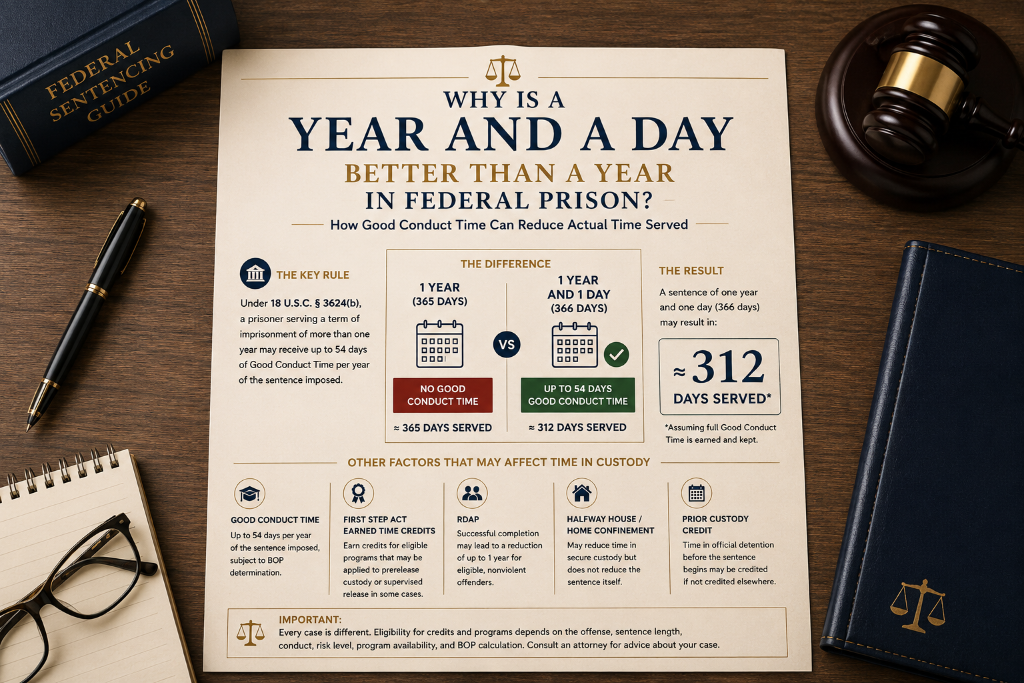
A sentence of one year and one day equals 366 days. Because it is more than one year, an eligible federal prisoner may receive up to 54 days of Good Conduct Time, assuming satisfactory conduct and compliance with Bureau of Prisons requirements.
The practical result is simple:
366 days minus 54 days equals approximately 312 days served.
That is why defense attorneys sometimes ask for a sentence of "one year and one day" instead of exactly twelve months. On paper, it is one day longer. In practice, it may result in weeks less in custody.
I. The Federal Sentencing Detail Most People Miss
Most people assume that a sentence of one year and a sentence of one year and one day are almost the same. In ordinary life, the difference is only twenty-four hours.
In federal prison sentence computation, however, that one extra day can make a major difference.
The reason is the language of the federal Good Conduct Time statute. Under 18 U.S.C. § 3624(b), an eligible prisoner serving a term of imprisonment of more than one year may receive up to 54 days of credit for each year of the sentence imposed by the court.
That phrase — more than one year — is the key.
A sentence of exactly twelve months is not more than one year. A sentence of twelve months and one day is.
That is why a sentence that appears slightly longer on paper may actually result in less time served.
II. How Much Time Is One Year and One Day in Federal Prison?
A sentence of one year and one day equals 366 days.
If the prisoner receives the full available Good Conduct Time, the calculation is:
366 days minus 54 days of Good Conduct Time equals approximately 312 days served
So, as a general rule, a federal sentence of one year and one day may come out to approximately 312 days in custody before considering any other credits or placements.
This is why the common statement that a year-and-a-day sentence equals "about 311 days" should be used carefully. The cleaner calculation is:
366 − 54 = 312
The exact projected release date may still depend on BOP's sentence computation, prior custody credit, disciplinary history, First Step Act credits, RDAP eligibility, halfway house placement, home confinement, and other administrative factors.
III. Why a Straight One-Year Sentence Can Be Worse
A straight one-year sentence is usually 365 days.
The problem is that a sentence of exactly one year does not cross the "more than one year" threshold under 18 U.S.C. § 3624(b). Because of that, the prisoner generally does not receive the same 54-day Good Conduct Time benefit.
That creates a counterintuitive result.
Sentence of Exactly One Year
- Sentence imposed: 365 days
- Good Conduct Time eligibility under the 54-day rule: Generally no
- Estimated time served: Close to 365 days, unless there is separate jail credit or another applicable reduction
Sentence of One Year and One Day
- Sentence imposed: 366 days
- Good Conduct Time eligibility: Yes, if otherwise eligible
- Potential Good Conduct Time: Up to 54 days
- Estimated time served: Approximately 312 days, assuming full credit is earned and kept
In practical terms, one extra day on paper can save approximately 53 days of actual custody compared with a straight one-year sentence.
IV. Why Judges Sometimes Use One Year and One Day
Federal judges, prosecutors, and defense attorneys who understand BOP sentence computation know that "one year and one day" is not just a technical phrase. It can affect the projected release date.
A judge may impose one year and one day when the court wants the sentence to remain close to one year but also wants the defendant to receive the benefit of Good Conduct Time.
This can be especially important when the court believes a custodial sentence is necessary but does not intend for the person to serve a full twelve months.
For defense attorneys, this is an important sentencing issue. If the court is considering a sentence near twelve months, counsel may ask for:
"A sentence of one year and one day so the defendant may be eligible for Good Conduct Time under federal law."
That request can make a real difference.
V. Is the 54-Day Credit Automatic?
Not exactly.
The safer and more accurate way to say it is that an eligible prisoner may receive up to 54 days of Good Conduct Time for each year of the sentence imposed.
BOP may initially calculate a projected release date using the maximum possible Good Conduct Time. However, that projected release date can change during the sentence.
Good Conduct Time can be affected by institutional disciplinary violations, education-related requirements, sentence computation issues, or other BOP determinations.
So the accurate rule is:
A one-year-and-one-day sentence may result in approximately 312 days served if the prisoner receives and keeps the full Good Conduct Time credit.
It should not be described as an unconditional automatic reduction in every case.
VI. Good Conduct Time Is Not the Same as First Step Act Time Credits
One common mistake is confusing Good Conduct Time with First Step Act earned time credits.
They are different.
Good Conduct Time comes from 18 U.S.C. § 3624(b). It is based on the sentence imposed and the prisoner's institutional conduct. This is the rule that makes one year and one day different from exactly one year.
First Step Act earned time credits are different. They are tied to participation in evidence-based recidivism reduction programs and productive activities. Eligible prisoners may earn credits that can later be applied toward prerelease custody or supervised release, depending on BOP calculation and statutory eligibility.
A prisoner may qualify for Good Conduct Time but not qualify for First Step Act earned time credits. Likewise, First Step Act credits have separate exclusions, risk assessments, program requirements, and application rules.
For the "one year and one day" issue, the key rule is Good Conduct Time, not First Step Act earned time credits.
VII. Can Programs Reduce the Time Even More?
Possibly, but it depends on eligibility.
Several separate mechanisms may reduce the amount of time a person spends in secure prison custody or allow earlier placement in the community.
The main ones are:
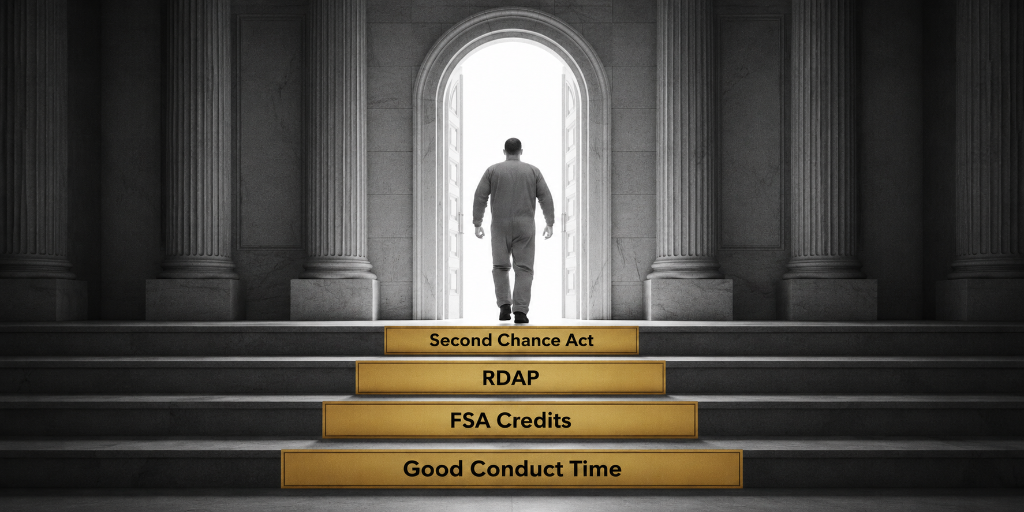
- Good Conduct Time
- First Step Act earned time credits
- RDAP
- Residential Reentry Center placement
- Home confinement
- Prior custody credit
Each one works differently.
VIII. First Step Act Earned Time Credits
First Step Act earned time credits may help eligible prisoners reduce the time they spend in secure custody.
Eligible prisoners can earn time credits by successfully participating in approved recidivism reduction programs or productive activities. Those credits may be applied toward prerelease custody, such as a Residential Reentry Center or home confinement, or toward an earlier transfer to supervised release.
However, not every prisoner is eligible. Some offenses are excluded. Risk level, needs assessment, disciplinary record, immigration status, program availability, and BOP calculation may affect whether credits are earned and applied.
For a short sentence like one year and one day, timing also matters. The prisoner must have enough time for assessment, program placement, participation, credit calculation, and application of those credits.
So the correct answer is:
First Step Act credits may help, but they are not guaranteed and may be limited in short-sentence cases.
IX. RDAP: Residential Drug Abuse Program
RDAP stands for the Residential Drug Abuse Program. It is a BOP substance abuse treatment program.
Eligible prisoners convicted of nonviolent offenses who successfully complete RDAP and meet BOP requirements may receive up to one year off their sentence.
But RDAP is not available to everyone. The prisoner generally needs a documented substance abuse history, must qualify under BOP rules, must be accepted into the program, and must not be excluded from early release eligibility.
For a sentence of one year and one day, RDAP may not always be practical because the program takes time to enter and complete. A short sentence may not leave enough time for full participation and early release benefit.
Still, when substance abuse history is relevant, RDAP should be addressed before sentencing because the presentence report, judgment recommendations, and BOP designation process can affect eligibility.
X. Halfway House and Home Confinement
A Residential Reentry Center, commonly called a halfway house, and home confinement may reduce the amount of time a person spends inside a prison facility.
But they are not the same as a sentence reduction.
A person in a halfway house or on home confinement is still serving the sentence under BOP authority. These placements are forms of prerelease custody designed to help with reentry.
Under 18 U.S.C. § 3624(c), BOP must, to the extent practicable, ensure that a prisoner spends a portion of the final months of the sentence under conditions that help prepare the person for reentry. This may include a community correctional facility.
Home confinement may also be available, but it is subject to statutory limits, BOP discretion, risk level, conduct, release plan, and other factors.
The important point is:
Halfway house and home confinement may reduce time inside a prison facility, but they do not necessarily reduce the sentence itself.
XI. Jail Credit Is Separate
Prior custody credit, often called jail credit, is also separate from Good Conduct Time.
Under 18 U.S.C. § 3585(b), a defendant may receive credit toward the federal sentence for time spent in official detention before the federal sentence begins, but only if that time has not already been credited against another sentence.
This matters because someone sentenced to one year and one day may serve less than 312 days if they also receive valid prior custody credit.
But if the same time was already credited toward another sentence, BOP generally cannot credit it again toward the federal sentence.
That is why the final projected release date depends on BOP's sentence computation.
XII. Practical Example
Assume two defendants are sentenced in federal court.
Defendant A: One Year
Defendant A receives exactly twelve months.
That equals approximately 365 days. Because the sentence is not more than one year, Defendant A generally does not qualify for the 54-day Good Conduct Time calculation.
Defendant A may serve close to the full year unless there is separate prior custody credit or another applicable reduction.
Defendant B: One Year and One Day
Defendant B receives twelve months and one day.
That equals 366 days. Because the sentence is more than one year, Defendant B may qualify for up to 54 days of Good Conduct Time.
The estimated calculation is:
366 days − 54 days = approximately 312 days served
So Defendant B received a sentence that is technically one day longer, but may serve significantly less time in custody.
XIII. Why This Matters Before Sentencing
The one-year-and-one-day issue matters most before the judgment is entered.
Once the written judgment says "12 months," BOP generally computes the sentence based on that judgment. BOP does not simply add one day to make the prisoner eligible for Good Conduct Time.
That is why this issue should be raised at sentencing when appropriate.
If the court is considering a sentence near twelve months, counsel should consider whether to request one year and one day so the defendant may qualify for Good Conduct Time.
In federal sentencing, small wording differences can have major real-world consequences.
XIV. Common Misunderstandings
"One year and one day means more time."
Not necessarily. It is more time on paper, but it may be less time in actual custody because of Good Conduct Time.
"The person automatically serves only 85 percent."
That is an oversimplification. The better explanation is that eligible prisoners may receive up to 54 days of Good Conduct Time for each year of the sentence imposed.
"The person will definitely serve 311 days."
The cleaner general estimate is approximately 312 days, because 366 minus 54 equals 312.
"Good Conduct Time and First Step Act credits are the same."
They are not the same. Good Conduct Time is based on sentence length and conduct. First Step Act credits are based on eligible programming and separate statutory requirements.
"Programs always reduce the sentence."
Not always. Some programs reduce time in secure custody. Some allow earlier transfer to halfway house or home confinement. Some may reduce the sentence for eligible prisoners. Each program has separate rules.
"The judge controls the exact release date."
The judge imposes the sentence. BOP calculates the release date, applies prior custody credit, calculates Good Conduct Time, reviews First Step Act credits, and determines prerelease custody placement.
Conclusion
A sentence of one year and one day can be better than a sentence of exactly one year because it crosses the federal Good Conduct Time threshold.
A sentence of exactly one year is usually 365 days and generally does not qualify for the 54-day Good Conduct Time calculation. A sentence of one year and one day is 366 days and may qualify.
With full Good Conduct Time, a one-year-and-one-day sentence may result in approximately 312 days served.
Other programs, including First Step Act earned time credits, RDAP, halfway house placement, home confinement, and prior custody credit, may also affect the actual time a person spends in prison or secure custody. But each one has separate rules, eligibility limits, and BOP calculation requirements.
In federal sentencing, details matter. Sometimes one extra day on paper can mean weeks less in actual custody.
Disclaimer: This article provides general legal information for educational purposes only. It is not legal advice and does not create an attorney-client relationship. Always consult a licensed attorney for advice regarding your specific legal situation.
Michael Alcocer
Michael Alcocer writes about legal topics in plain English, helping readers understand criminal justice, court procedure, sentencing, appeals, and civil rights.