Unlocking a Second Chance: How the Second Chance Act Can Help Federal Prisoners Transition Home
Key Takeaways
- The Second Chance Act allows BOP to consider federal prisoners for prerelease custody during the final portion of their sentence.
- Prerelease custody may include placement in a Residential Reentry Center (halfway house) or home confinement.
- The law allows up to 12 months of prerelease custody, but that does not mean every prisoner automatically receives 12 months.
- Home confinement under the Second Chance Act is generally limited to the shorter of 10 percent of the sentence or 6 months.
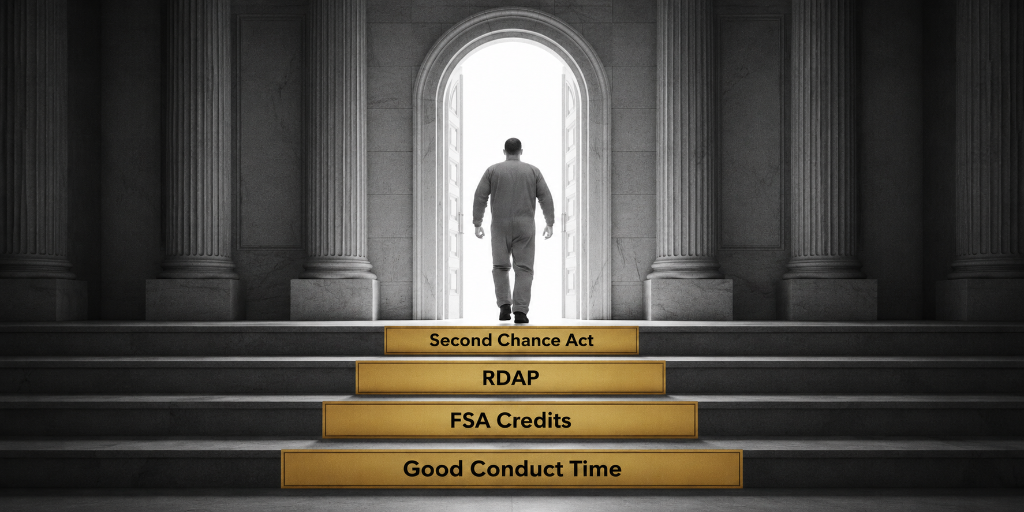
- Federal sentence reduction should be reviewed in layers: Good Conduct Time first, then FSA credits, then RDAP if applicable, and finally Second Chance Act prerelease placement.
- These benefits may be stackable in the right case: GCT, FSA credits, RDAP early release, and SCA placement can work together to reduce secure custody time.
- The Second Chance Act does not replace Good Conduct Time, FSA credits, or RDAP; it works as part of the final reentry strategy.
- A strong release plan can help maximize the combined benefit of GCT, FSA, RDAP, halfway house placement, and home confinement.
I. What Is the Second Chance Act?
The Second Chance Act is one of the most important federal reentry laws for people in Bureau of Prisons custody. Signed into law in 2008, the Act was designed to reduce recidivism, improve public safety, and help people return to society with more structure, support, and accountability.
For federal prisoners, the most practical part of the Second Chance Act is its connection to prerelease custody. Under federal law, BOP must, to the extent practicable, ensure that a prisoner spends a portion of the final months of the sentence under conditions that give the prisoner a reasonable opportunity to adjust to and prepare for reentry into the community.
Those conditions may include placement in a Residential Reentry Center, commonly known as a halfway house. In appropriate cases, BOP may also place a prisoner on home confinement.
The purpose is simple: a person should not be released from prison with no plan, no support, no housing stability, no employment pathway, and no connection to treatment or family resources. The Second Chance Act is intended to create a bridge between prison and full release.
II. The Second Chance Act Is Not Automatic Early Release
One of the biggest misunderstandings about the Second Chance Act is that it automatically gives a prisoner one year off the sentence. That is not correct.
The Second Chance Act does not erase the sentence. It does not automatically reduce the term of imprisonment. Instead, it gives BOP authority to transfer an eligible prisoner to prerelease custody during the final portion of the sentence.
That distinction matters.
A prisoner in a halfway house or on home confinement is still serving the sentence. The person remains under BOP authority and must follow strict rules. Violations can result in removal from the program and return to a secure facility.
So, the better way to understand the Second Chance Act is this:
It does not guarantee freedom, but it can create a pathway from prison custody to community custody before the final release date.
III. How Much Halfway House Time Can BOP Give?
The statute allows BOP to consider a prisoner for prerelease custody for up to 12 months of the final portion of the sentence.
That phrase — "up to 12 months" — is important. It means 12 months is possible, but it is not guaranteed.
BOP is required to make an individualized assessment. The agency looks at factors such as:
- the prisoner's institutional conduct;
- disciplinary history;
- risk and needs assessment;
- public safety concerns;
- release residence;
- employment prospects;
- family support;
- medical or mental health needs;
- programming completed;
- substance abuse treatment needs;
- immigration or detainer issues;
- length of sentence remaining;
- resources available at the Residential Reentry Center;
- whether the requested placement is necessary for successful reintegration; and
- whether home confinement may be more appropriate than halfway house placement.
Some prisoners may receive several months. Some may receive less. Some may be considered better candidates for direct home confinement, depending on their risk level, needs, and release plan.
The key point is that the request should be supported by facts, documentation, and a realistic reentry plan.
IV. Home Confinement Under the Second Chance Act
Home confinement is different from halfway house placement.
Under the Second Chance Act framework, BOP may use prerelease custody authority to place a prisoner in home confinement for the shorter of:
- 10 percent of the term of imprisonment; or
- 6 months.
The law also states that BOP should, to the extent practicable, place prisoners with lower risk levels and lower needs on home confinement for the maximum amount of time permitted.
This is especially important for people who have a stable residence, strong family support, employment prospects, no recent serious disciplinary issues, and limited need for the structured services of a halfway house.
In 2025, BOP issued guidance emphasizing that home confinement should be prioritized for eligible individuals who do not need the structured support of a Residential Reentry Center. That policy direction matters because it recognizes that some people are better served by transitioning directly into a stable home environment rather than occupying limited halfway house bedspace.
V. BOP's 2025 Policy Shift: The Proposed 60-Day Cap Was Rescinded
In 2025, there was significant concern after BOP announced guidance that would have limited certain Second Chance Act placements in Residential Reentry Centers to 60 days. That proposed limitation caused serious alarm because many federal prisoners rely on halfway house placement for employment, housing, treatment, family reunification, and reentry planning.
However, BOP later rescinded that guidance and stated that it would not proceed with the planned 60-day limitation.
That update is critical. Prisoners, families, and advocates should not assume that the Second Chance Act has been permanently reduced to only 60 days. The statute still allows individualized consideration for up to 12 months of prerelease custody, subject to BOP discretion, available resources, and the facts of the case.
This is why timing and documentation matter. When BOP policies shift, a prisoner with a well-prepared file is in a stronger position to request the maximum placement allowed by law and policy.
VI. How the Second Chance Act Fits with Good Conduct Time, FSA Credits, and RDAP
The Second Chance Act should not be viewed in isolation. In many federal cases, the strongest release strategy requires looking at several BOP-administered benefits together: Good Conduct Time, First Step Act credits, RDAP early release, and Second Chance Act prerelease placement.
These benefits are different, but when properly understood, they may work together to shorten time in secure custody and maximize a person's transition into the community.
This is where the word stackable becomes important.
In the right case, these benefits may be stackable because each one operates under a different legal authority and may affect a different part of the federal sentence calculation or release process. A strong release strategy does not look at only one program. It looks at the full picture.
1. Good Conduct Time: The First Reduction
The first major sentence calculation issue is Good Conduct Time, often called GCT.
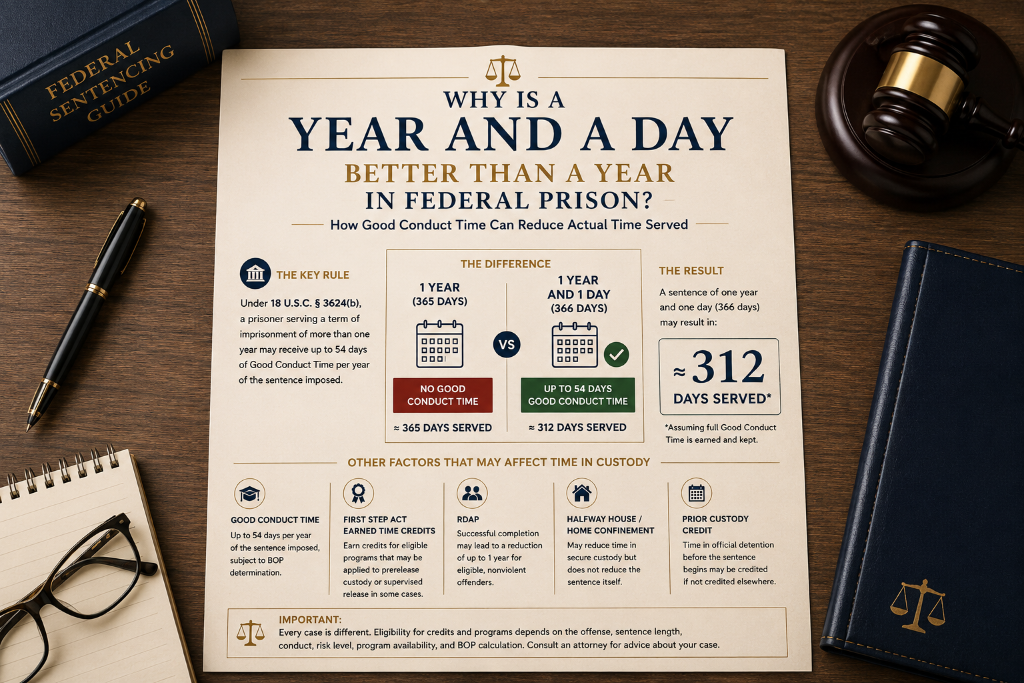
For most federal prisoners serving more than one year, BOP may award up to 54 days of Good Conduct Time for each year of the sentence imposed by the court, assuming the person maintains satisfactory institutional conduct. Many people describe this as the "15% good time" reduction because, practically speaking, a person who earns all available Good Conduct Time may serve approximately 85% of the imposed sentence.
This is usually the first reduction applied to the sentence computation. It creates the projected release date that becomes the starting point for analyzing other benefits.
However, Good Conduct Time is not automatic in the sense that misconduct can affect it. A prisoner must protect that credit by maintaining clear conduct and complying with institutional rules.
2. First Step Act Credits: Up to 365 Days Toward Supervised Release, Plus Prerelease Custody
After Good Conduct Time, the next major issue is First Step Act time credits.
Eligible prisoners can earn FSA credits by successfully participating in evidence-based recidivism reduction programs and productive activities. These credits can be applied toward prerelease custody, such as Residential Reentry Center placement or home confinement.
In eligible cases, FSA credits may also be applied to transfer the prisoner to supervised release earlier, up to 12 months.
This is where many federal sentence calculations become more complex. A prisoner may have a projected release date after Good Conduct Time, then earn FSA credits that move the community placement date earlier or allow earlier transfer to supervised release.
But FSA credits depend on eligibility. Certain convictions are excluded. Risk level, programming participation, immigration status, disciplinary record, detainers, and BOP's calculation process can all affect whether and how those credits are applied.
3. RDAP: Another Possible Reduction of Up to 365 Days
For prisoners with qualifying substance abuse history and eligible convictions, the Residential Drug Abuse Program, known as RDAP, can provide another powerful benefit.
A person who successfully completes RDAP and meets BOP's early release criteria may receive up to one year off the sentence. This is separate from Good Conduct Time and separate from the Second Chance Act.
RDAP is not available to everyone. The prisoner must qualify medically and legally, must be accepted into the program, must complete the required treatment components, and must remain eligible for the early release benefit. Some offenses, detainers, prior conduct, or other disqualifying factors can affect eligibility.
When RDAP applies, it can substantially improve the release timeline because it may reduce the amount of time the person must serve in custody.
4. Second Chance Act: The Final Community Placement Tool
After Good Conduct Time, FSA credits, and any applicable RDAP reduction are reviewed, the Second Chance Act becomes especially important for the final transition period.
The Second Chance Act allows BOP to consider a prisoner for prerelease custody during the final portion of the sentence. This can include placement in a Residential Reentry Center, commonly called a halfway house, or home confinement.
The law allows up to 12 months of prerelease custody, but that does not mean every prisoner automatically receives 12 months. BOP must make an individualized decision based on the person's needs, risk level, conduct, release plan, family support, employment prospects, treatment needs, public safety concerns, and available resources.
This is why the Second Chance Act package matters. The prisoner should not simply ask for "maximum halfway house time." The request should explain why that time is necessary for successful reintegration.
5. Why These Benefits Can Be Stackable
In the right case, Good Conduct Time, First Step Act credits, RDAP early release, and Second Chance Act placement may be stackable. That means each benefit should be reviewed separately, then analyzed together to determine how they may combine to reduce time in secure custody and maximize community placement.
This does not mean every federal prisoner automatically receives every benefit. Each program has its own eligibility rules, exclusions, limits, and BOP procedures. But when a person qualifies, these benefits may work together in layers.
First, Good Conduct Time may reduce the sentence calculation.
Second, First Step Act credits may move the person earlier into prerelease custody or, in some cases, supervised release.
Third, RDAP may provide up to 365 days of early release for eligible participants.
Finally, the Second Chance Act may help maximize halfway house placement or home confinement during the final portion of the sentence.
This is why the word stackable matters. A strong release strategy does not look at one program in isolation. It looks at the full federal sentence-reduction structure and asks how each available benefit can legally and practically build on the others.
VII. Example of a Stackable Release Strategy
A federal prisoner's release planning may look something like this:
- The sentence is first reduced by Good Conduct Time, assuming the prisoner maintains clear conduct.
- If eligible, the prisoner earns First Step Act credits through approved programming and productive activities.
- If the prisoner qualifies for RDAP, completes the program, and remains eligible, BOP may award up to 365 days of RDAP early release.
- After those calculations are reviewed, the prisoner may still be considered for Second Chance Act placement into a halfway house or home confinement.
- If the prisoner has stable housing, community support, employment prospects, and a strong reentry plan, BOP may consider a longer or more appropriate community placement.
This type of layered analysis is critical because the goal is not just to ask for one benefit. The goal is to determine every lawful benefit available and then maximize the combined effect.
That is the heart of a stackable release strategy.
VIII. What BOP Looks For in a Strong Second Chance Act Request
A strong Second Chance Act request should not be a generic letter asking for "maximum halfway house time." BOP is supposed to evaluate individual needs and public safety. Therefore, the request should explain why the requested placement is necessary and appropriate.
A persuasive request usually addresses the following areas:
1. Institutional Conduct
The prisoner should show a record of good behavior, respect for rules, and positive adjustment while incarcerated. Disciplinary history matters. Recent serious incident reports can hurt the request.
2. Program Participation
Completed programs can help show rehabilitation and readiness. This may include education, vocational training, drug treatment, mental health programming, faith-based programming, financial literacy, parenting classes, anger management, or other productive activities.
3. Release Residence
A verified and stable release address is important. For home confinement, the residence should be appropriate, safe, and free from criminal activity or substance abuse concerns.
4. Employment or Job Search Plan
A prisoner does not always need secured employment before placement, but having a realistic employment plan can strengthen the request. This may include job offers, prior work history, vocational training, resume preparation, business plans, or family-supported employment opportunities.
5. Family and Community Support
Letters from family members, mentors, employers, clergy, community organizations, or treatment providers can help demonstrate support and accountability.
6. Treatment and Medical Needs
If the person needs substance abuse treatment, mental health counseling, medical care, or medication management, the release plan should explain how those needs will be addressed in the community.
7. Public Safety
BOP will consider whether the prisoner can be safely managed in the community. A strong plan should address supervision, accountability, transportation, treatment compliance, and any risk factors.
IX. Common Mistakes That Can Hurt a Second Chance Act Request
Many prisoners lose valuable time because the request is incomplete, vague, late, or unsupported.
Common mistakes include:
- assuming 12 months is automatic;
- waiting too long to prepare;
- submitting a generic request with no evidence;
- failing to document housing;
- failing to explain employment plans;
- ignoring disciplinary history;
- overstating eligibility;
- confusing First Step Act credits with Second Chance Act placement;
- failing to review RDAP eligibility early;
- failing to involve family or community support early;
- not following up with the Unit Team;
- not addressing risk factors honestly; and
- not reviewing whether the benefits may be stackable.
The best request is specific, organized, truthful, and supported by documents.
X. When Should a Prisoner Start Preparing?
Preparation should begin well before the final year of the sentence.
A prisoner should begin building the record early by completing programs, avoiding disciplinary issues, developing a release address, gathering support letters, and preparing employment or treatment plans.
By the time the Unit Team reviews the prisoner for prerelease placement, the file should already show a clear pattern of rehabilitation and readiness.
Waiting until the last minute can create unnecessary problems. Halfway house bedspace, home confinement review, address verification, treatment planning, administrative processing, FSA credit application, and RDAP review all take time.
The earlier the preparation begins, the stronger the argument becomes.
XI. What Families Can Do to Help
Families play a major role in successful reentry. A prisoner's family can help by gathering documents, confirming housing, communicating with potential employers, locating treatment providers, preparing transportation plans, and writing support letters.
A strong family support letter should be specific. It should explain where the person will live, who will provide support, what responsibilities the person will have, and how the family will help the person comply with supervision.
Families should avoid exaggeration. The goal is not to make unrealistic promises. The goal is to show stability, accountability, and a realistic transition plan.
Family support can also help identify whether the prisoner may benefit from a stackable strategy involving Good Conduct Time, First Step Act credits, RDAP, and Second Chance Act placement.
XII. Practical Checklist for a Second Chance Act Package
A strong Second Chance Act package may include:
- request letter to the Unit Team;
- proposed release address;
- family support letters;
- employment letter or job search plan;
- resume;
- certificates of completed programming;
- education or vocational records;
- disciplinary record summary;
- FSA programming record;
- RDAP eligibility or completion documentation, if applicable;
- medical or treatment plan, if applicable;
- proof of identification documents or plan to obtain them;
- transportation plan;
- community support contacts;
- proposed home confinement plan;
- explanation of why the requested placement period is necessary;
- explanation of how GCT, FSA, RDAP, and SCA may be stackable in the case; and
- any sentencing court recommendation, if available.
Every case is different. The package should match the person's actual needs and circumstances.
XIII. How Jail Time Consulting Helps
At Jail Time Consulting, we help federal prisoners and families understand how the Second Chance Act works and how it may interact with other BOP-administered benefits.
Our goal is to help prepare a clear, organized, and fact-based reentry request that addresses the issues BOP actually reviews.
This may include reviewing:
- projected release date issues;
- Good Conduct Time;
- First Step Act credit eligibility;
- RDAP eligibility and early release potential;
- Second Chance Act placement;
- halfway house timing;
- home confinement eligibility;
- release residence;
- support letters;
- institutional programming;
- disciplinary history;
- family support;
- employment planning; and
- community reintegration needs.
The key is preparation. A prisoner should not wait until the last minute and hope BOP gives maximum placement automatically. A stronger approach is to document eligibility, show rehabilitation, and present a complete release plan.
When the benefits are stackable, the strategy becomes even more important. Each available benefit should be reviewed separately, then combined into one clear reentry plan.
XIV. Conclusion: A Second Chance Requires Preparation
The Second Chance Act remains one of the most important tools for federal prisoners preparing to return home. It can provide meaningful prerelease custody through a halfway house or home confinement, but it is not automatic and it is not guaranteed.
BOP must consider each person individually. That means the prisoner's conduct, programming, release plan, risk level, family support, employment prospects, treatment needs, and public safety concerns all matter.
But the Second Chance Act is only one part of the larger federal release picture.
The strongest strategy reviews Good Conduct Time, First Step Act credits, RDAP, and Second Chance Act placement together. In the right case, these benefits may be stackable, helping reduce time in secure custody and maximize the transition back into the community.
For many people, the Second Chance Act is more than a policy. It is the bridge between incarceration and rebuilding a life.
Disclaimer: This article provides general legal information for educational purposes only. It is not legal advice and does not create an attorney-client relationship. Always consult a licensed attorney for advice regarding your specific legal situation.
Michael Alcocer
Michael Alcocer writes about legal topics in plain English, helping readers understand criminal justice, court procedure, sentencing, appeals, and civil rights.