Pinkerton, Relevant Conduct, and the Modern Drug Conspiracy
Key Takeaways
- Pinkerton is a substantive-liability doctrine, not a sentencing rule
- U.S.S.G. § 1B1.3 requires individualized sentencing inquiry
- Foreseeability alone is not enough for Guidelines accountability
- Drug quantity must be tied to defendant's jointly undertaken activity
- Courts must make particularized findings before attributing co-conspirator conduct
- Evans and Bright (4th Cir.) foreclose Pinkerton-style Guidelines calculations
Executive Summary
Federal drug conspiracies often create a dangerous sentencing shortcut: the government proves a broad conspiracy, then attempts to attribute the full scope of that conspiracy to every participant. But Pinkerton liability and Guidelines relevant conduct are not the same doctrine. Pinkerton may support substantive criminal liability for reasonably foreseeable offenses committed by co-conspirators in furtherance of the conspiracy. By contrast, U.S.S.G. § 1B1.3 requires a narrower, individualized sentencing inquiry focused on the scope of the criminal activity the defendant personally agreed to jointly undertake. The Sentencing Commission's current relevant-conduct materials emphasize that sentencing accountability is not always coextensive with criminal liability as a principal, accomplice, or conspirator.
Key Takeaways
- Pinkerton is a substantive-liability doctrine. It can make a conspirator criminally liable for certain offenses committed by co-conspirators.
- U.S.S.G. § 1B1.3 is a sentencing-accountability rule. It does not automatically import the entire conspiracy into the Guidelines calculation.
- Foreseeability alone is not enough. The conduct must also fall within the scope of the defendant's jointly undertaken criminal activity.
- Drug quantity must be individualized. A defendant is not automatically responsible for the full drug quantity distributed by a large organization.
- Courts must make particularized findings. A sentencing court must identify the scope of the defendant's agreement before attributing co-conspirator conduct.
- Evans and Bright are major modern authorities. The Fourth Circuit has made clear that courts may not use the broader Pinkerton standard when applying § 1B1.3 drug-quantity or Guidelines accountability.
I. The Core Problem: One Conspiracy, Different Levels of Culpability
Large drug conspiracies are rarely uniform. A leader, supplier, organizer, courier, driver, stash-house operator, street-level dealer, money collector, and occasional participant may all be charged in the same conspiracy. Yet their actual culpability may be dramatically different.
The danger in large-scale prosecutions is that the government may treat the conspiracy as one indivisible unit and ask the sentencing court to attribute the entire drug quantity, all firearms, all threats, all premises, and all conduct to every defendant.
That approach conflicts with the structure of the Sentencing Guidelines.
A conspiracy conviction proves that the defendant joined an unlawful agreement. But it does not automatically prove that the defendant agreed to jointly undertake every act committed by every other participant. The Guidelines focus on the specific acts and omissions for which the defendant should be held accountable in calculating the advisory range, not simply whether the defendant could be held criminally liable under conspiracy law.
II. Substantive Liability Under Pinkerton
In Pinkerton v. United States, 328 U.S. 640 (1946), the Supreme Court held that a conspirator may be held liable for substantive offenses committed by a co-conspirator when those offenses are committed in furtherance of the conspiracy and fall within the scope of the unlawful project. Pinkerton also recognized an important limitation: a different case would exist if the substantive offense was not in furtherance of the conspiracy, did not fall within the scope of the unlawful project, or was not reasonably foreseeable as a necessary or natural consequence of the unlawful agreement.
That doctrine is powerful. It allows the government to pursue substantive criminal liability even when the defendant did not personally commit the substantive act. For example, if a co-conspirator distributes drugs, transports narcotics, uses a firearm, or commits another substantive offense in furtherance of the conspiracy, Pinkerton may permit liability if the required conditions are satisfied.
But Pinkerton answers a trial-liability question. It does not automatically answer the sentencing-accountability question under § 1B1.3.
That distinction is critical.
III. Relevant Conduct Under U.S.S.G. § 1B1.3
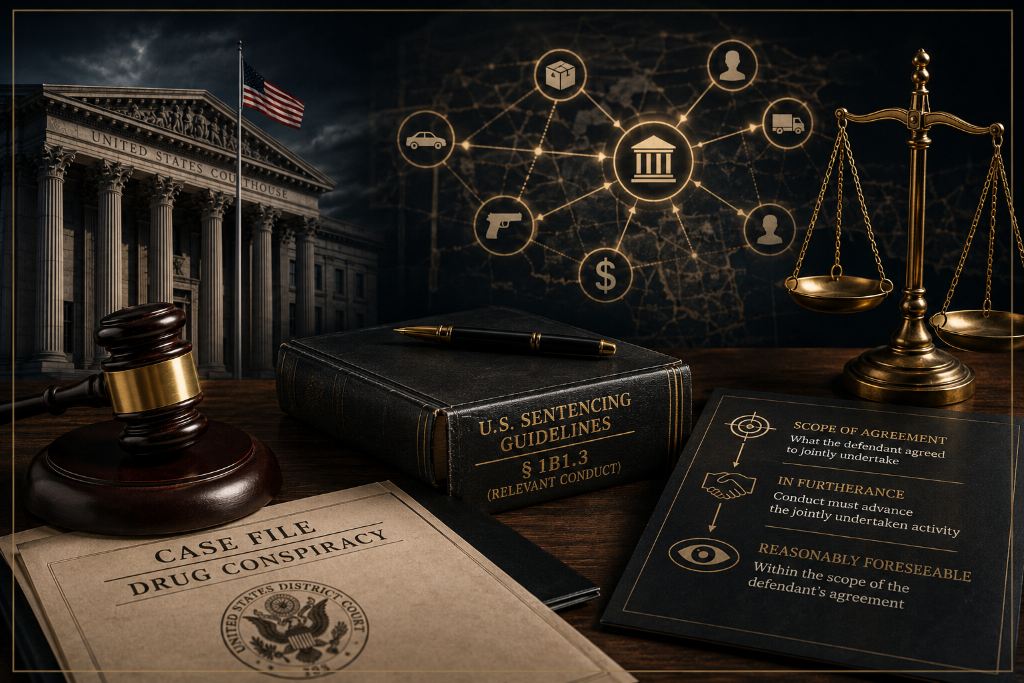
The Sentencing Guidelines take a narrower approach. Under U.S.S.G. § 1B1.3(a)(1)(B), a defendant is accountable for the acts and omissions of others only when those acts were:
- Within the scope of the jointly undertaken criminal activity;
- In furtherance of that criminal activity; and
- Reasonably foreseeable in connection with that criminal activity.
All three requirements matter. The Sentencing Commission's 2026 Relevant Conduct Primer describes § 1B1.3 as defining the range of conduct relevant to determining the applicable offense level and explains that the relevant-conduct analysis begins with the offense of conviction but then takes account of real-offense characteristics.
The Guidelines expressly distinguish the scope of the entire conspiracy from the scope of the defendant's own jointly undertaken criminal activity. The scope of a defendant's agreement does not automatically include all conduct by members of a conspiracy, and it does not include conduct occurring before the defendant joined the conspiracy merely because the defendant later learned about it.
That means a defendant may be guilty of a drug conspiracy but still responsible at sentencing for a narrower quantity of drugs than the conspiracy as a whole.
IV. Scope Comes First
The most important word in § 1B1.3 is scope.
Before a court asks whether another person's conduct was foreseeable, it must determine the specific criminal activity the defendant agreed to jointly undertake. That agreement may be explicit, or it may be implicit based on the defendant's conduct and the conduct of others. But the court still must identify the defendant's own undertaking.
The Guidelines do not ask merely: Was the defendant part of the conspiracy?
They ask: What criminal activity did this defendant agree to jointly undertake?
That is a narrower question.
Mere knowledge of a broader conspiracy is insufficient. A defendant may know that other people are distributing drugs, carrying firearms, storing narcotics, or moving larger quantities. But knowledge does not automatically establish agreement. If the defendant's own undertaking was limited, sentencing accountability must be limited as well.
This is the core principle:
Awareness is not agreement.
V. Why This Matters Most in Drug Quantity Cases
Drug quantity often drives the entire Guidelines range in federal narcotics cases. Under U.S.S.G. § 2D1.1, drug type and drug weight can dramatically increase the base offense level. In a large conspiracy, the difference between personal quantity and conspiracy-wide quantity can mean years — sometimes decades — of additional imprisonment.
For sentencing purposes, the court should not simply ask:
How much did the conspiracy distribute?
The correct question is narrower:
How much drug quantity is attributable to this defendant based on his own acts and the reasonably foreseeable acts of others that were within the scope of his jointly undertaken criminal activity?
This distinction prevents low-level or limited-role defendants from being sentenced as if they personally joined every transaction, supply chain, stash house, distribution route, and firearm-related episode connected to a large organization.
For example:
- A courier may be accountable for the drugs he transported and quantities reasonably foreseeable within his transportation agreement.
- A street-level seller may be accountable for his sales and jointly undertaken sales activity, but not automatically for all supplier-level transactions.
- A late-joining participant is not automatically accountable for drugs distributed before he joined, even if he later learned about those earlier distributions.
- A defendant who knows others are moving larger quantities is not automatically accountable for those quantities unless his own agreement encompassed that larger activity.
The Sentencing Commission's current primer gives precisely this kind of limitation: the scope of the defendant's agreement does not extend to conspiracy conduct before the defendant joined, even if the defendant knows of that prior conduct.
VI. Evans: The Modern Fourth Circuit Warning Against Collapsing Pinkerton Into § 1B1.3
United States v. Evans, 90 F.4th 257 (4th Cir. 2024) is one of the most important modern cases on this issue.
In Evans, the Fourth Circuit held that the district court erred by using the broader Pinkerton standard to determine the defendant's accountable drug weight for sentencing purposes. The district court asked whether the drugs seized from a co-conspirator were within the scope of the entire conspiracy and reasonably foreseeable under Pinkerton. The Fourth Circuit held that this was the wrong standard. For sentencing, the court had to apply § 1B1.3's narrower relevant-conduct framework.
Evans is critical because it directly addresses the recurring mistake in large drug cases: treating conspiracy-wide conduct as automatically attributable to the defendant. The Fourth Circuit explained that before drugs seized from a co-conspirator may be attributed to a defendant at sentencing, the district court must make particularized findings about the scope of the defendant's agreement to jointly undertake criminal activity and foreseeability.
The Evans rule can be summarized simply:
Pinkerton may define substantive criminal liability, but § 1B1.3 defines Guidelines sentencing accountability.
That distinction can change the Guidelines range dramatically.
VII. Bright: Evans Applied Beyond Drug Quantity
United States v. Bright, 125 F.4th 97 (4th Cir. 2025) reinforces Evans and shows that the Pinkerton / § 1B1.3 distinction is not limited to drug-weight disputes.
In Bright, the Fourth Circuit held that § 1B1.3 applies when determining Chapter Three adjustments, including role adjustments under § 3B1.1. The court explained that a district court must make particularized findings regarding the scope of the jointly undertaken criminal activity, whether the acts of others were in furtherance of that activity, and whether those acts were reasonably foreseeable.
Bright is important because the court expressly stated that the district court conflated the standard for substantive Pinkerton liability with the standard for sentencing accountability under § 1B1.3, and that this was significant procedural error.
That language is powerful for defense counsel because it frames the issue not merely as a disagreement over drug quantity, but as a procedural sentencing error.
VIII. Particularized Findings Are Required
Before attributing co-conspirator conduct to a defendant at sentencing, courts must make particularized findings regarding:
- The scope of the defendant's agreement;
- Whether the conduct of others was in furtherance of that jointly undertaken activity; and
- Whether the conduct was reasonably foreseeable in connection with that activity.
A PSR's broad description of the conspiracy is not enough. A general statement that the defendant was part of a large drug conspiracy is not enough. A sentencing court must connect the attributed conduct to the defendant's own jointly undertaken criminal activity.
This matters because relevant conduct is not necessarily the same for every participant. In large conspiracies, different defendants may have different scopes of agreement, different levels of knowledge, different roles, different time periods of participation, and different reasonably foreseeable quantities.
The Fourth Circuit's Bright decision makes the practical point clearly: a defendant need not know every person who touched the drugs, but he must have agreed to jointly undertake the criminal activity being used to support the Guidelines calculation.
IX. Foreseeability Alone Is Insufficient
Foreseeability appears in both Pinkerton and § 1B1.3, but it does not perform the same work in each context.
Under Pinkerton, foreseeability helps determine whether a defendant can be held substantively liable for a co-conspirator's offense. Under § 1B1.3, foreseeability is only one part of the relevant-conduct test.
The Guidelines require more. The conduct must also be within the scope of the defendant's jointly undertaken criminal activity and in furtherance of that activity. The Sentencing Commission's primer cites the Tenth Circuit's formulation that the scope of the agreement and reasonable foreseeability are independent and necessary elements of relevant conduct.
This means courts may not reason backward from foreseeability to scope. The government cannot simply say:
Because the defendant knew the conspiracy was large, all drug quantity was foreseeable.
That is not enough.
The correct question is:
Did the defendant agree to jointly undertake the criminal activity that produced that quantity?
If the answer is no, the conduct should not be attributed under § 1B1.3, even if the defendant knew about the broader conspiracy.
X. Amendment 826 and Acquitted Conduct
The modern relevant-conduct landscape also changed with Amendment 826, effective November 1, 2024. The Sentencing Commission revised § 1B1.3 to exclude acquitted conduct from the scope of relevant conduct used in calculating the Guidelines range, unless that conduct also establishes, in whole or in part, the instant offense of conviction.
This does not eliminate all uncharged or dismissed conduct from sentencing. The 2026 Relevant Conduct Primer explains that Amendment 826 did not alter the use of uncharged, dismissed, or other relevant conduct as otherwise defined in § 1B1.3. But it does create an important objection where a PSR attempts to use acquitted federal conduct to increase the advisory range.
In a drug conspiracy case, counsel should examine whether the PSR relies on:
- Acquitted conduct;
- Dismissed conduct;
- Uncharged transactions;
- Pre-joining conduct;
- Conduct after withdrawal;
- Conduct outside the defendant's agreed undertaking; or
- Conduct supported only by generalized conspiracy allegations.
XI. Circuit-by-Circuit Application: Broad Consensus, Different Emphasis
Although courts sometimes use different language, the general rule across the circuits is consistent: Pinkerton liability and Guidelines relevant conduct are related but not identical. Pinkerton concerns substantive criminal liability for reasonably foreseeable offenses committed by co-conspirators in furtherance of the conspiracy. Section 1B1.3 requires a narrower sentencing inquiry focused on the defendant's own jointly undertaken criminal activity.
This is not best described as a circuit split. It is better described as broad doctrinal consensus with different emphasis among the circuits.
A. Fourth Circuit: Evans, Bright, and the Strongest Modern Statement
The Fourth Circuit has given one of the clearest modern explanations of the distinction.
In Evans, the court held that the district court committed procedural error by using the broader Pinkerton standard to calculate drug quantity under the Guidelines. In Bright, the Fourth Circuit reiterated that courts must apply § 1B1.3 and make particularized findings before attributing co-conspirator conduct for Guidelines purposes.
Fourth Circuit rule: Conflating Pinkerton with § 1B1.3 is procedural error.
B. First Circuit: Laboy and Salvador-Gutierrez
The First Circuit has emphasized the importance of tying Guidelines accountability to the defendant's own conduct or agreement. United States v. Laboy, 351 F.3d 578 (1st Cir. 2003) supports the principle that mere knowledge of a co-conspirator's activity is not enough; the defendant must have agreed, explicitly or implicitly, to jointly undertake the relevant criminal activity.
More recently, United States v. Salvador-Gutierrez, 128 F.4th 299 (1st Cir. 2025) (en banc), rejected the use of a Guidelines enhancement based solely on reasonable foreseeability where the relevant enhancement required conduct by "the defendant." Although Salvador-Gutierrez involved § 3B1.4 rather than drug quantity, it reinforces a larger point: courts must not mechanically import Pinkerton-style vicarious liability into Guidelines provisions that require defendant-specific conduct.
First Circuit rule: Foreseeability matters, but it must be tied to the defendant's own agreement or to the specific Guidelines provision being applied.
C. Second Circuit: Studley and Individualized Scope Findings
The Second Circuit has long required individualized findings before attributing co-conspirator conduct to a defendant. In United States v. Studley, 47 F.3d 569 (2d Cir. 1995), the court explained that a defendant participating in jointly undertaken criminal activity may be sentenced based on acts committed by others only when those acts were in furtherance of the jointly undertaken activity and reasonably foreseeable to the defendant.
Studley is especially useful because it supports the "awareness is not agreement" argument. A defendant may understand that a larger operation exists, but the Guidelines require more than awareness. The court must define what the defendant actually agreed to jointly undertake.
Second Circuit rule: Knowledge of the overall operation is not enough; the court must define the defendant's agreed-upon scope.
D. Sixth Circuit: McReynolds and the "Significantly Narrower" Rule
The Sixth Circuit has used strong language favorable to defendants. In United States v. McReynolds, 964 F.3d 555 (6th Cir. 2020), the court stated that the scope of relevant conduct for drug amounts under § 1B1.3(a)(1)(B) is "significantly narrower" than the conduct needed to obtain a conspiracy conviction.
That distinction is critical in drug cases. A defendant may be convicted of joining a conspiracy, but that does not automatically mean every drug transaction by the conspiracy becomes his relevant conduct.
Sixth Circuit rule: Conspiracy guilt does not equal conspiracy-wide drug quantity.
E. Seventh Circuit: Broad Pinkerton Concepts, But Scope Still Matters
The Seventh Circuit has historically applied Pinkerton principles broadly in conspiracy cases. But its Guidelines cases still recognize that relevant conduct turns on conduct reasonably foreseeable to the defendant that furthered criminal activity the defendant agreed to undertake jointly with others. See United States v. Young, 997 F.2d 1204 (7th Cir. 1993); Gray-Bey v. United States, 156 F.3d 733 (7th Cir. 1998).
Seventh Circuit rule: Pinkerton remains robust, but Guidelines accountability still requires a defendant-specific relevant-conduct analysis.
F. Eighth Circuit: Spotted Elk and the Limits of Borrowing Pinkerton
The Eighth Circuit has recognized that § 1B1.3 borrows from Pinkerton concepts but does not make Guidelines accountability identical to Pinkerton liability. In United States v. Spotted Elk, 548 F.3d 641 (8th Cir. 2008), the Eighth Circuit addressed multiple convictions arising from a drug trafficking operation, and later relevant-conduct discussions have cited Spotted Elk for the point that sentencing accountability must focus on the defendant's agreed undertaking.
Eighth Circuit rule: Pinkerton concepts may inform the analysis, but § 1B1.3 still limits sentencing accountability to the defendant's own undertaking.
G. Ninth Circuit: Defendant-Specific Drug Quantity
The Ninth Circuit also recognizes that drug quantity must be tied to the defendant's own conduct or qualifying co-conspirator conduct. In large drug cases, the court may not simply adopt conspiracy-wide quantities without reliable defendant-specific support.
Ninth Circuit rule: PSR drug quantity findings require careful defendant-specific support when the quantity is based on co-conspirator conduct.
H. Tenth Circuit: Scope and Foreseeability Are Independent Requirements
The Tenth Circuit has one of the cleanest formulations of the rule. The Sentencing Commission's 2026 primer cites United States v. Willis, 476 F.3d 1121 (10th Cir. 2007) for the proposition that the scope of the agreement and reasonable foreseeability are independent and necessary elements of relevant conduct.
Tenth Circuit rule: Foreseeability cannot substitute for scope; both must be independently satisfied.
I. Eleventh Circuit: Individualized Findings and No Automatic Pre-Joining Conduct
The Eleventh Circuit also requires individualized relevant-conduct findings. Unpublished Eleventh Circuit cases, including United States v. Barona-Bravo, 685 F. App'x 761 (11th Cir. 2017), have criticized the conflation of the full conspiracy with the defendant's individual agreement and recognize that conduct before a defendant joined the conspiracy generally cannot be attributed merely because it was part of the larger conspiracy.
Because some Eleventh Circuit cases in this area are unpublished, they should be used carefully as persuasive authority. But they align with the Guidelines commentary and the broader circuit consensus.
Eleventh Circuit rule: The court should define the defendant's jointly undertaken activity before evaluating foreseeability.
J. What the Circuit Survey Shows
The circuit cases support four core conclusions.
First, Pinkerton liability is broader than Guidelines relevant conduct. Pinkerton may allow substantive liability for reasonably foreseeable offenses committed by co-conspirators in furtherance of the conspiracy, but § 1B1.3 requires a more precise sentencing inquiry.
Second, scope comes before foreseeability. A sentencing court must first determine what criminal activity the defendant agreed to jointly undertake. Only then may the court decide whether another person's conduct was in furtherance of that activity and reasonably foreseeable.
Third, conspiracy-wide quantity is not automatically defendant-specific quantity. In drug cases, the sentencing court must connect drug quantity to the defendant's own acts or to the qualifying acts of others under § 1B1.3.
Fourth, particularized findings matter. Especially after Evans and Bright, a sentencing court risks procedural error when it attributes co-conspirator conduct without defining the defendant's jointly undertaken criminal activity.
XII. Standard of Review and Procedural Posture
The distinction between Pinkerton liability and § 1B1.3 relevant conduct also matters because the applicable standard changes depending on where the case stands procedurally: sentencing, direct appeal, or collateral review under 28 U.S.C. § 2255.
A. Sentencing Level: Burden, Objections, and Particularized Findings
At sentencing, the issue is not technically a "standard of review" question. It is a burden-and-finding question.
The government bears the burden of proving disputed Guidelines facts by a preponderance of the evidence, including drug quantity and the facts necessary to attribute co-conspirator conduct under § 1B1.3. The Fourth Circuit's 2025 decision in United States v. Faulls, 148 F.4th 280 (4th Cir. 2025) restates the general principle that the government bears the burden of proving a contested enhancement by a preponderance of the evidence.
The district court must also resolve disputed PSR matters. Federal Rule of Criminal Procedure 32(i)(3)(B) requires the court, for any disputed portion of the PSR or other controverted matter, to rule on the dispute or determine that a ruling is unnecessary because the matter will not affect sentencing or will not be considered.
For jointly undertaken criminal activity, the district court must apply the narrower § 1B1.3 framework, not the broader Pinkerton framework. This requires findings that the conduct of others was within the scope of the defendant's jointly undertaken activity, in furtherance of that activity, and reasonably foreseeable in connection with that activity. Bright expressly states that a sentencing court should make these particularized findings before holding a defendant accountable for co-conspirator conduct.
This means a defendant should object specifically to any PSR paragraph that attributes conspiracy-wide drug quantity without identifying the defendant's own jointly undertaken criminal activity. A general objection that the drug quantity is "too high" may not be enough. The objection should force the court to answer:
What exactly did this defendant agree to jointly undertake?
B. Direct Appeal: De Novo, Clear Error, Due Deference, and Plain Error
On direct appeal, the standard depends on the nature of the issue.
A preserved legal challenge — for example, whether the district court applied Pinkerton instead of § 1B1.3 — is generally reviewed closer to de novo because it concerns the legal framework governing the sentence. Factual findings — such as drug quantity, credibility, scope of agreement, or foreseeability — are generally reviewed for clear error. Faulls explains that the standard of review for Guidelines application depends on whether the dispute is mostly legal or mostly factual: factual determinations receive clear-error review, while legal interpretation of a Guideline term moves closer to de novo review.
Section 3742 also instructs appellate courts to accept district-court factual findings unless clearly erroneous and to give due deference to the district court's application of the Guidelines to the facts.
For the overall sentence, appellate courts review for procedural and substantive reasonableness. Bright states that a sentence is procedurally unreasonable if the district court commits serious procedural error, including improperly calculating the Guidelines range.
If the defendant failed to object at sentencing, appellate review is usually for plain error. That makes preservation critical. A Guidelines error can still matter under plain-error review because an incorrect Guidelines range often affects the sentence. In Molina-Martinez v. United States, 578 U.S. 189 (2016), the Supreme Court held that when a court uses an incorrect Guidelines range, a defendant ordinarily does not need additional evidence to show that the error affected the sentence, even if the imposed sentence also falls within the correct range.
In practical terms, an Evans-style error is strongest on direct appeal when counsel preserved the issue by objecting that the district court used conspiracy-wide or Pinkerton-style attribution instead of § 1B1.3's narrower individualized inquiry.
C. Section 2255 Proceedings: Collateral Review Is Much Harder
A § 2255 motion is not a second direct appeal. It is a collateral remedy that allows a federal prisoner to challenge a sentence imposed in violation of the Constitution or laws of the United States, imposed without jurisdiction, exceeding the statutory maximum, or otherwise subject to collateral attack.
That distinction matters. A defendant who failed to raise a Pinkerton / § 1B1.3 sentencing issue at trial or on direct appeal may face procedural default. In a § 2255 proceeding, a pure Guidelines-calculation error is often difficult to litigate unless it rises to a constitutional or jurisdictional level, produced a sentence above the lawful statutory maximum, or is connected to ineffective assistance of counsel.
The stronger § 2255 framing is usually not simply:
The court misapplied § 1B1.3.
The stronger framing is often:
Counsel was ineffective for failing to object to conspiracy-wide attribution where § 1B1.3 required individualized findings, and that failure prejudiced the Guidelines range and sentence.
That framing moves the issue from ordinary Guidelines error into a Sixth Amendment ineffective-assistance claim.
XIII. Practical Defense Framework at Sentencing
A strong relevant-conduct objection should force the court to answer six questions.
1. What did the defendant personally do?
Start with § 1B1.3(a)(1)(A): the defendant's own acts, aided-and-abetted acts, commanded acts, induced acts, procured acts, or willfully caused acts.
2. What criminal activity did the defendant agree to jointly undertake?
This is the threshold question under § 1B1.3(a)(1)(B). The court must define the defendant's specific agreement.
3. Was the conduct of others within that agreed scope?
Conduct outside the defendant's agreed undertaking is not relevant conduct, even if committed by members of the broader conspiracy.
4. Was the conduct in furtherance of that jointly undertaken activity?
The conduct must further the defendant's undertaking, not merely the conspiracy in general.
5. Was the conduct reasonably foreseeable in connection with that undertaking?
Foreseeability must be tied to the jointly undertaken criminal activity. It cannot expand the undertaking after the fact.
6. Did the court make particularized findings?
A PSR's broad conspiracy narrative is not enough. The sentencing court should make findings specific to the defendant.
XIV. Sample Sentencing Argument Language
The defense objection can be framed this way:
The PSR improperly attributes conspiracy-wide drug quantity to the defendant without making individualized findings under U.S.S.G. § 1B1.3(a)(1)(B). Pinkerton liability and Guidelines relevant conduct are not coextensive. Before attributing the acts of others to the defendant, the Court must determine the scope of the specific criminal activity the defendant agreed to jointly undertake, whether the acts of others were in furtherance of that undertaking, and whether those acts were reasonably foreseeable in connection with that undertaking. Knowledge of a larger conspiracy is insufficient.
A sharper version:
The government has shown, at most, that the defendant knew of a broader drug operation. But awareness is not agreement. Section 1B1.3 requires proof of the defendant's jointly undertaken criminal activity, not the conspiracy's outer limits.
And in a Fourth Circuit case after Evans and Bright:
Evans and Bright foreclose the use of the broader Pinkerton standard to calculate Guidelines accountability. The Court must apply § 1B1.3's narrower three-part test and make particularized findings regarding the defendant's own jointly undertaken criminal activity.
XV. Preservation Checklist
Defense counsel should preserve the issue clearly and repeatedly.
- Object to conspiracy-wide drug quantity in the PSR.
- Object to any firearm, premises, role, violence, or obstruction enhancement based on generalized co-conspirator conduct.
- Demand individualized § 1B1.3 findings on scope, furtherance, and foreseeability.
- Argue that Pinkerton liability cannot substitute for Guidelines relevant conduct.
- Request a Rule 32 ruling on each disputed PSR allegation.
- If the court overrules the objection, request a clear explanation of the factual basis for the ruling.
- Preserve the issue for direct appeal.
A concise preservation objection could read:
The defense objects to the PSR's attribution of conspiracy-wide drug quantity. Pinkerton liability and Guidelines relevant conduct are not coextensive. Under U.S.S.G. § 1B1.3(a)(1)(B), the Court must make particularized findings regarding the scope of the criminal activity this defendant agreed to jointly undertake, whether the conduct of others was in furtherance of that jointly undertaken activity, and whether the conduct was reasonably foreseeable in connection with that activity. Mere membership in, or knowledge of, a broader conspiracy is insufficient.
For direct appeal, the issue can be framed as:
The district court procedurally erred by applying the broader Pinkerton standard instead of the narrower § 1B1.3 relevant-conduct standard when calculating drug quantity.
For § 2255, the more realistic framing is:
Counsel rendered ineffective assistance by failing to object to the PSR's conspiracy-wide drug-quantity attribution despite § 1B1.3's requirement of individualized findings. There is a reasonable probability that, had counsel objected, the Guidelines range would have been lower.
XVI. Conclusion
The modern drug conspiracy requires careful separation between three different concepts: conspiracy liability, Pinkerton substantive liability, and Guidelines relevant conduct.
Pinkerton may expand criminal liability for substantive offenses committed by co-conspirators. But at sentencing, § 1B1.3 demands individualized findings. A defendant is not automatically responsible for every kilogram, firearm, stash house, violent act, premises, role enhancement, or transaction connected to a sprawling conspiracy.
The correct rule is narrower and more precise:
Sentencing accountability depends on the scope of the defendant's own jointly undertaken criminal activity, acts in furtherance of that undertaking, and reasonable foreseeability within that undertaking.
The circuit cases point in the same direction. The Fourth Circuit's Evans and Bright decisions provide the clearest recent warning against collapsing Pinkerton into relevant conduct. The First, Second, Sixth, Seventh, Eighth, Tenth, and Eleventh Circuits likewise recognize that sentencing accountability must be individualized, even if they express the rule with different emphasis.
The procedural posture also matters. At sentencing, the defendant must force the district court to make particularized § 1B1.3 findings. On direct appeal, preserved legal errors are reviewed more favorably than unpreserved ones, and an incorrect Guidelines range can justify remand. On § 2255 review, however, the same issue becomes much harder because collateral review is limited and often requires a constitutional framing, such as ineffective assistance of counsel.
The safest and strongest approach is to preserve the Pinkerton / § 1B1.3 distinction early, clearly, and repeatedly.
Final rule:
A defendant may be guilty of joining a conspiracy, but he is not automatically accountable at sentencing for everything the conspiracy did.
References
- Pinkerton v. United States, 328 U.S. 640 (1946).
- U.S.S.G. § 1B1.3, Relevant Conduct.
- Fed. R. Crim. P. 32(i)(3)(B).
- 18 U.S.C. § 3742.
- 28 U.S.C. § 2255.
- United States v. Evans, 90 F.4th 257 (4th Cir. 2024).
- United States v. Bright, 125 F.4th 97 (4th Cir. 2025).
- United States v. Flores-Alvarado, 779 F.3d 250 (4th Cir. 2015).
- United States v. Faulls, 148 F.4th 280 (4th Cir. 2025).
- United States v. Laboy, 351 F.3d 578 (1st Cir. 2003).
- United States v. Salvador-Gutierrez, 128 F.4th 299 (1st Cir. 2025) (en banc).
- United States v. Studley, 47 F.3d 569 (2d Cir. 1995).
- United States v. McReynolds, 964 F.3d 555 (6th Cir. 2020).
- United States v. Young, 997 F.2d 1204 (7th Cir. 1993).
- Gray-Bey v. United States, 156 F.3d 733 (7th Cir. 1998).
- United States v. Spotted Elk, 548 F.3d 641 (8th Cir. 2008).
- United States v. Willis, 476 F.3d 1121 (10th Cir. 2007).
- United States v. Barona-Bravo, 685 F. App'x 761 (11th Cir. 2017) (unpublished).
- Molina-Martinez v. United States, 578 U.S. 189 (2016).
Disclaimer: This article provides general legal information for educational purposes only. It is not legal advice and does not create an attorney-client relationship. Always consult a licensed attorney for advice regarding your specific legal situation.
Michael Alcocer
Michael Alcocer writes about legal topics in plain English, helping readers understand criminal justice, court procedure, sentencing, appeals, and civil rights.