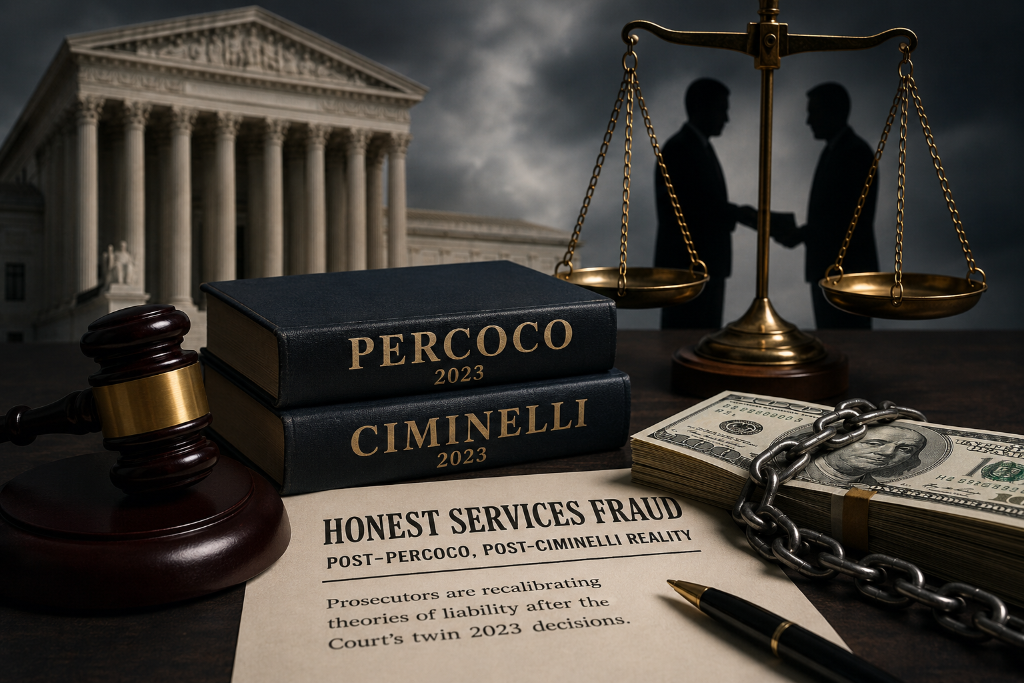
Honest Services Fraud: The Post-Percoco, Post-Ciminelli Reality
Key Takeaways
- Ciminelli eliminated the 'right-to-control' theory of wire fraud
- Percoco rejected vague 'influence' theories for honest-services duty
- Lower courts have substantially converged on the core rules
- Kousisis clarified that federal fraud does not require proof of net pecuniary loss
- The government's safest path is now traditional fraud or bribery
Executive Summary
The Supreme Court's 2023 decisions in Percoco v. United States and Ciminelli v. United States significantly narrowed two aggressive federal fraud theories. Percoco limited when a private citizen can be treated as owing honest services to the public, while Ciminelli rejected the Second Circuit's "right-to-control" theory of wire fraud. The result is not the end of honest-services prosecutions, but a more disciplined landscape: prosecutors must now identify a concrete fiduciary duty, a bribery or kickback theory, or a traditional property interest.
I. The Pre-2023 Problem: Federal Fraud as an Anti-Corruption Catchall
For decades, federal prosecutors used mail fraud, wire fraud, honest-services fraud, and conspiracy statutes as flexible tools in public corruption and commercial bribery cases. The basic statutes were usually 18 U.S.C. § 1343 for wire fraud, § 1346 for honest-services fraud, and § 1349 for conspiracy.
That flexibility made the statutes powerful. It also made them vulnerable. The Supreme Court has repeatedly warned that federal fraud law cannot become a general federal code of ethics. Fraud statutes punish schemes to obtain money, property, or honest services in a legally defined sense. They do not criminalize every lie, conflict of interest, undisclosed relationship, political favor, or breach of good-government norms.
That concern reached a new point in 2023 when the Court decided Percoco and Ciminelli on the same day.
II. Ciminelli: The End of "Right-to-Control" Fraud
Ciminelli involved the Second Circuit's long-standing "right-to-control" theory. Under that theory, the government could prove wire fraud by showing that the defendant deprived the victim of potentially valuable economic information necessary to make discretionary economic decisions.
The Supreme Court rejected that theory. The Court held that the federal fraud statutes protect traditional property interests. The right to make an informed economic decision is not itself a traditional property interest. Therefore, depriving someone of information—even economically important information—is not enough unless the scheme is directed at money or property.
After Ciminelli, prosecutors cannot simply argue:
The victim would have acted differently if it had known the truth.
They must prove something closer to:
The defendant used deceit to obtain money, property, contracts, loan proceeds, payments, confidential property, or another recognized property interest.
That distinction now drives motions to dismiss, Rule 29 motions, jury-instruction objections, direct appeals, and post-conviction challenges.
III. Percoco: Influence Is Not Automatically Honest-Services Duty
Percoco addressed a different question: when can a private citizen owe the public a duty of honest services?
Joseph Percoco had been a senior aide to New York Governor Andrew Cuomo. During an eight-month period when he was outside formal government employment and working on the Governor's reelection campaign, he accepted payments and contacted a state official about a government-related issue. The government charged him with honest-services wire fraud.
The Supreme Court did not hold that a private person can never owe honest services to the public. But it rejected the vague jury instruction used in Percoco's case. The instruction allowed liability if the jury found that Percoco had a "special relationship" with the government and had "dominated and controlled" government business. The Court found that standard too indefinite.
After Percoco, prosecutors must identify the source of the duty. They cannot rely on political influence alone.
A viable theory may require proof that the private actor was acting as an actual agent of the government, exercising governmental authority, formally selected for future government service, or otherwise bound by a recognized fiduciary or agency-based duty.
Mere access is not enough. Friendship is not enough. Political influence is not enough. A "special relationship" is not enough unless it maps onto a legally cognizable duty.
IV. What Survives After Percoco and Ciminelli
Honest-services fraud remains viable when the government charges a classic bribery or kickback scheme.
The strongest post-2023 cases involve a clear duty of loyalty and a corrupt exchange. That includes:
- a public official accepting a bribe;
- an employee taking kickbacks from a vendor;
- an agent steering business for secret payments;
- a fiduciary selling out the principal;
- a private intermediary participating in a bribery scheme involving an official act;
- a public servant agreeing to act because of corrupt compensation.
The theory can no longer be merely that the conduct was deceptive, unethical, or politically improper. The government must connect the conduct to bribery, kickbacks, fiduciary breach, or property fraud.
V. Post-2023 Lower-Court Application of Percoco and Ciminelli
The lower courts have substantially converged around three principles after Percoco and Ciminelli: first, the "right-to-control" theory is no longer viable; second, honest-services fraud must rest on a legally cognizable duty and, after Skilling, a bribery or kickback theory; and third, wire fraud must be tied to money or traditional property rather than an abstract right to accurate information.
A. Abandonment of the Right-to-Control Theory
Lower courts have recognized that Ciminelli ended the theory that a defendant commits wire fraud merely by depriving the victim of valuable economic information needed to make a discretionary decision. The Supreme Court made clear that the federal fraud statutes protect traditional property interests, not the intangible right to control one's assets through complete information.
United States v. Robbins is a useful example. There, the District of Maine considered Ciminelli and Percoco after defendants moved to dismiss fraud-related counts. The court acknowledged that Ciminelli rejected the right-to-control theory, but denied dismissal because the indictment alleged schemes rooted in traditional property interests rather than mere deprivation of information.
That distinction is now critical. If the indictment alleges only that the victim lacked information, Ciminelli creates a serious problem for the government. But if the indictment alleges that the defendant used lies to obtain money, loan proceeds, government funds, contracts, or other property, Ciminelli usually will not defeat the case at the threshold.
B. Clarification of Honest-Services Fraud Liability
After Percoco, courts have been more careful about the source of the duty in honest-services fraud cases. The government must show more than informal influence, political access, or a relationship with public officials.
In Robbins, the court explained that Percoco rejected the old Margiotta standard because it failed to define honest-services liability with sufficient clarity. The problem in Percoco was not simply that the defendant was outside formal government employment; it was that the jury was allowed to convict based on vague concepts like "special relationship" and "domination and control."
That principle now affects both indictments and jury instructions. Prosecutors must identify a duty that comes from law, employment, agency, fiduciary status, or a comparable source. Defense counsel, in turn, should challenge any instruction that permits conviction based only on influence, access, informal power, or political proximity.
C. Jury Instructions Are Now a Major Battleground
The post-Percoco and post-Ciminelli cases also show that jury instructions are no longer a secondary issue. They are often the central issue.
If a jury is instructed on an invalid "right-to-control" theory, the conviction may be vulnerable. If a jury is instructed that a private citizen may owe honest services to the public based on vague influence or a "special relationship," the conviction may also be vulnerable.
The Shetty litigation illustrates this instructional battleground. In that case, the Western District of Washington addressed proposed jury instructions in a wire-fraud prosecution, with the parties disputing how fraud instructions should be framed after Ciminelli. The case reflects the broader post-2023 trend: courts are scrutinizing whether instructions properly limit fraud liability to recognized property interests and valid theories of deception.
D. The First, Fifth, and Seventh Circuits Show the Emerging Pattern
The Second Circuit has had to recalibrate the most because the invalid right-to-control theory came from its own precedent. The Fifth and Seventh Circuits were less disrupted because they generally had not depended on that theory in the same way. Their post-Ciminelli cases tend to emphasize that fraud remains viable where the object of the scheme is money, loan funds, loan guarantees, or other traditional property.
The First Circuit's post-Percoco cases, including cases connected to public corruption and the "Varsity Blues" prosecutions, show a different emphasis: the government's bribery and honest-services theories may survive, but the jury instructions must be legally precise and must not permit conviction based on an invalid theory.
The common point is this: courts are not reading Percoco and Ciminelli as abolishing federal fraud prosecutions. They are reading them as requiring cleaner theories, clearer instructions, and a closer fit between the charged conduct and the statutory text.
VI. The Pecuniary-Loss Question After Kousisis
Before Kousisis, defendants often argued that federal fraud required proof that the victim suffered or was intended to suffer net economic loss. That argument gained traction in some courts because if the victim received the benefit of its bargain, defendants argued there was no true property fraud.
Kousisis narrowed that defense. The Supreme Court held that a defendant who induces a victim to enter a transaction through materially false pretenses may be convicted of federal fraud even if the defendant did not seek to cause the victim economic loss. The Court explained that the fraud statutes do not impose a general economic-loss requirement.
That does not undo Ciminelli. The government still must prove that money or property was an object of the scheme. But after Kousisis, the focus is less on whether the victim ultimately lost money and more on whether the defendant used material lies to obtain money or property.
The cleaner formulation is:
After Kousisis, federal fraud does not require proof of net pecuniary loss, but it still requires that the object of the scheme be money or property.
That is the post-2025 bridge between Ciminelli and modern fraudulent-inducement prosecutions.
VII. Prosecutorial Strategy After the 2023–2026 Cases
The Department of Justice is not abandoning fraud prosecutions. It is adjusting them.
The safer post-Percoco, post-Ciminelli charging theories include:
-
Traditional property fraud The indictment identifies money, loan proceeds, contract payments, government funds, or other property obtained through deceit.
-
Fraudulent inducement after Kousisis The lie caused the victim to enter a transaction and transfer money or property, even if the victim received goods or services in return.
-
Classic honest-services bribery or kickbacks The defendant owed a duty of loyalty and accepted, solicited, or facilitated a corrupt payment in exchange for breaching that duty.
-
Federal-program bribery under § 666 The government proves a bribe—not merely a gratuity—and ties the payment to governmental business.
-
Conspiracy, obstruction, or money-laundering add-ons Where the underlying fraud or bribery theory is strong, prosecutors may add laundering, false statement, obstruction, or conspiracy charges.
The weaker theories are now easier to attack. These include cases based primarily on undisclosed conflicts, political access, loss of information, generalized unfairness, or vague assertions that a defendant "influenced" government decision-making.
VIII. Defense Arguments After Percoco, Ciminelli, and Kousisis
1. Challenge the Property Theory
Defense counsel should ask:
- What property was obtained?
- Was money or property the object of the scheme?
- Is the government merely alleging loss of information?
- Is the indictment repackaging "right to control" in different words?
If the alleged harm is only that the victim lacked information, Ciminelli is a strong defense tool.
2. Challenge the Fiduciary Duty
After Percoco, the defense should ask:
- Who owed the duty?
- To whom was the duty owed?
- What law, agency relationship, employment relationship, or fiduciary principle created that duty?
- Is the government relying on influence instead of legal duty?
A vague duty theory can support a motion to dismiss, a jury-instruction objection, a Rule 29 motion, or an appellate sufficiency challenge.
3. Attack Vague Jury Instructions
The jury instructions matter. Percoco and Ciminelli both rejected theories that allowed juries to convict without clear statutory limits.
Defense counsel should object to instructions that allow conviction based on:
- influence;
- access;
- undisclosed conflicts alone;
- deprivation of information alone;
- political favoritism;
- generalized unfairness;
- "domination" or "control" without a legally defined duty.
4. Separate Ethics Violations from Federal Crimes
Not every conflict of interest is honest-services fraud. Not every lie is wire fraud. Not every relationship is bribery. Not every after-the-fact payment is a federal crime.
The defense should force the government to identify the exact element that transforms misconduct into a federal felony.
IX. The Bottom Line
The post-Percoco, post-Ciminelli reality is not that federal fraud law is dead. It is that broad, amorphous theories are weaker.
The government must now be more precise. It must identify the property, the fiduciary duty, the bribe, the kickback, the agency relationship, the material lie, and the corrupt exchange.
Lower courts have largely aligned around that framework. The right-to-control theory is no longer viable. Honest-services fraud requires a legally grounded duty and a bribery or kickback theory. And after Kousisis, prosecutors do not need to prove net pecuniary loss, but they still must prove that the scheme was directed at obtaining money or property.
For prosecutors, the safest cases are traditional fraud and bribery cases with concrete proof. For defendants, the strongest challenges expose when the government is trying to punish conduct that may be unethical, political, civil, or regulatory—but not criminal under the statutes Congress actually enacted.
Disclaimer: This article provides general legal information for educational purposes only. It is not legal advice and does not create an attorney-client relationship. Always consult a licensed attorney for advice regarding your specific legal situation.
Michael Alcocer
Michael Alcocer writes about legal topics in plain English, helping readers understand criminal justice, court procedure, sentencing, appeals, and civil rights.