BOP Federal Sentence Computations: How Release Dates Are Calculated

Key Takeaways
- Federal sentence computations are calculated by the Bureau of Prisons through the Designation and Sentence Computation Center — not by the sentencing judge.
- A projected release date is built from several moving parts: sentence imposed, commencement date, prior custody credit, good conduct time, First Step Act credits, RDAP credits, and prerelease placement decisions.
- Prior custody credit under 18 U.S.C. § 3585(b) generally cannot be double-counted if the same time was already credited to another sentence.
- First Step Act Time Credits: earning credits and having them applied are two different issues — eligibility, risk level, and detainers all affect application.
- Up to 365 days of First Step Act credits may apply toward early transfer to supervised release; additional credits may support earlier placement in prerelease custody.
- If a BOP calculation appears wrong, raise it first with Correctional Systems staff, then through the Administrative Remedy process (BP-9 → BP-10 → BP-11).
Key Takeaways
- Federal sentence computations are not handled by the sentencing judge after sentencing. They are calculated by the Bureau of Prisons through the Designation and Sentence Computation Center.
- A projected release date is built from several moving parts: sentence imposed, sentence commencement date, prior custody credit, good conduct time, First Step Act credits, RDAP credits, and prerelease placement decisions.
- Prior custody credit is limited by 18 U.S.C. § 3585(b) and generally cannot be double-counted if the same time was already credited to another sentence.
- First Step Act Time Credits are earned through qualifying programming and productive activities, but earning credits and having them applied are two different issues.
- Up to 365 days of First Step Act credits may be applied toward early transfer to supervised release. Additional credits may still support earlier placement in prerelease custody, including a Residential Reentry Center or home confinement.
- If an inmate believes the BOP calculation is wrong, the issue should first be raised with Correctional Systems staff, then through the Administrative Remedy process if it is not resolved.
Introduction
Few issues matter more to a federal defendant or federal prisoner than the release date. Families often ask a simple question: "When is he coming home?" But in federal custody, that answer is rarely as simple as subtracting months from a sentence.
The Bureau of Prisons calculates federal release dates through a technical sentence computation process. That process includes statutory credits, BOP policy, prior custody rules, good conduct time, First Step Act Time Credits, program credits, and prerelease custody decisions.
This article explains how BOP federal sentence computations work, why projected release dates change, and what steps can be taken when the calculation appears wrong.
I. Who Calculates a Federal Sentence?
After a federal defendant is sentenced and designated to BOP custody, the sentence computation is handled by the Bureau of Prisons, not by the sentencing court.
The BOP's sentence computation functions are carried out through the Designation and Sentence Computation Center, commonly known as the DSCC, located at the Grand Prairie Office Complex in Grand Prairie, Texas.
The BOP calculates federal sentences under federal statutes and BOP sentence computation manuals, including:
- Program Statement 5880.28, Sentence Computation Manual — CCCA 1984;
- Program Statement 5880.30, Sentence Computation Manual — Old Law / Pre-CCCA 1984;
- Program Statement 5880.32, District of Columbia Sentence Computation Manual.
For most modern federal cases, Program Statement 5880.28 is the primary manual because it applies to offenses sentenced under the Sentencing Reform Act / Comprehensive Crime Control Act framework.
The sentencing judge imposes the sentence. The BOP computes how that sentence is served.
II. The Basic Sentence Computation Formula
At a simplified level, a federal sentence computation asks:
What is the full sentence imposed by the court, when did it legally begin, what prior custody credit applies, what statutory good time applies, and what additional credits or programs may reduce the time in secure custody?
The basic components are:
- The sentence imposed by the court;
- The date the sentence begins;
- Prior custody credit;
- Good Conduct Time;
- First Step Act Time Credits;
- RDAP early release credit, if applicable;
- Residential Reentry Center or home confinement placement;
- Any sentence adjustments caused by disciplinary sanctions, detainers, loss of credits, or changes in eligibility.
Each part matters. A mistake in one part can change the projected release date by weeks, months, or in some cases more than a year.
III. Sentence Commencement Date
Under 18 U.S.C. § 3585(a), a federal sentence begins when the defendant is received in custody awaiting transportation to, or voluntarily arrives to begin service of the sentence at, the official detention facility where the sentence will be served.
This date is important because the sentence cannot be calculated correctly unless the BOP knows when the sentence legally started.
A common mistake is assuming that a federal sentence always starts on the sentencing date. That is not always true. The commencement date can become complicated when the person is in state custody, borrowed through a writ, has pending charges, or is serving another sentence.
In general, the earliest a federal sentence can begin is the date it is imposed, but the actual commencement analysis depends on custody status and whether the defendant was received for service of the federal sentence.
IV. Prior Custody Credit
Prior custody credit is governed by 18 U.S.C. § 3585(b). This provision allows credit for time spent in official detention before the federal sentence begins if the detention resulted from:
- The offense for which the federal sentence was imposed; or
- Another charge for which the defendant was arrested after committing the federal offense.
However, there is a major limitation: the time cannot be credited if it has already been credited against another sentence.
This is the "no double credit" rule.
For example, if a person spent six months in state custody and the state sentence already credited that six months, the BOP generally will not also credit that same six months toward the federal sentence. This is one of the most common sources of confusion in federal sentence calculations.
The Supreme Court has recognized that the Attorney General, through the BOP, computes prior custody credit after the defendant begins serving the sentence. The district court can make recommendations or structure the sentence in certain ways, but the BOP performs the actual credit calculation.
V. Good Conduct Time
Good Conduct Time, often called GCT, is separate from First Step Act Time Credits.
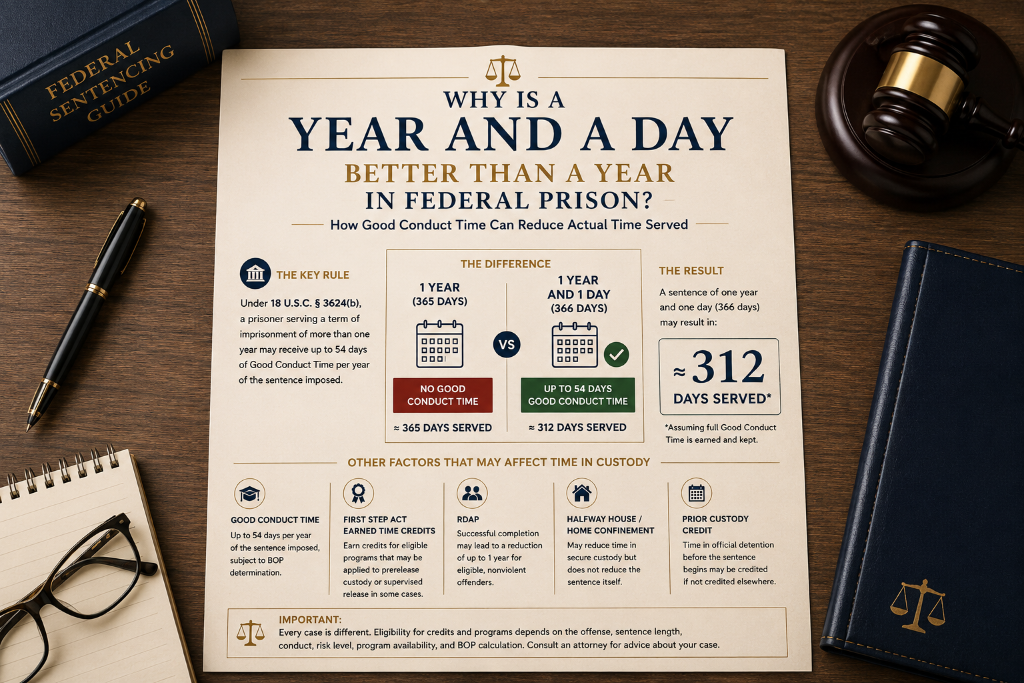
Under 18 U.S.C. § 3624(b), eligible federal inmates may receive up to 54 days of good conduct time for each year of the sentence imposed, subject to statutory and disciplinary rules.
Good Conduct Time is usually the first major reduction people see in a projected release date. For example, a 60-month federal sentence does not usually mean the person serves exactly 60 months in secure custody if the person earns full good conduct time.
But GCT is not automatic in the sense that it is untouchable. Serious disciplinary violations can result in the loss or disallowance of good conduct time.
VI. First Step Act Time Credits
The First Step Act created a separate credit system known as First Step Act Time Credits, often abbreviated as FSA credits, FTCs, or ETCs.
These credits are earned through successful participation in Evidence-Based Recidivism Reduction programs and Productive Activities recommended by the BOP based on the inmate's individualized risk and needs assessment.
The basic earning rule is:
- 10 days of credit for every 30 days of successful participation; and
- An additional 5 days of credit for every 30 days if the inmate is assessed as minimum or low risk and maintains that status over two consecutive assessments.
This creates the commonly discussed "10-day rate" and "15-day rate."
A person at medium or high risk may earn credits at the 10-day rate, but the higher 15-day rate requires the minimum/low-risk requirement and two consecutive qualifying assessments.
VII. Earning Credits Is Not the Same as Applying Credits
One of the biggest misunderstandings about the First Step Act is the difference between earning credits and applying credits.
An inmate may be eligible to earn credits, but that does not automatically mean every earned credit will immediately reduce the projected release date.
The BOP must determine:
- Whether the offense is eligible;
- Whether the inmate is in earning status;
- Whether the inmate participated successfully in recommended programming or productive activities;
- Whether the inmate has maintained the required PATTERN risk level;
- Whether detainers, pending charges, immigration issues, or final removal orders affect application;
- Whether the credits are being applied toward supervised release or prerelease custody.
This is why private First Step Act calculators can only estimate. They may be useful for planning, but the BOP's official computation controls the actual projected release date.
VIII. The 365-Day Limit: "One Year Off" Is Not the Whole Story
Many people describe the First Step Act as allowing "one year off." That is partly true, but incomplete.
Up to 365 days of First Step Act Time Credits may be applied toward early transfer to supervised release. This means that if a person qualifies, the BOP may move the person from BOP custody to supervised release up to 12 months earlier than the person otherwise would have reached supervised release.
However, credits beyond 365 days may still matter.
Additional earned credits may be applied toward prerelease custody, such as:
- Residential Reentry Center placement;
- Halfway house placement;
- Home confinement.
So the better way to understand the rule is this:
The supervised release reduction is capped at 365 days, but additional First Step Act credits may still support earlier community placement.
This distinction is critical for release planning.
IX. Who Is Not Eligible for First Step Act Time Credits?
Not every federal inmate is eligible to earn First Step Act Time Credits.
The statute excludes numerous categories of offenses. These generally include many violent offenses, terrorism-related offenses, espionage, human trafficking, sex offenses, certain firearms offenses, and some serious drug offenses.
A person may also face problems applying credits if there are:
- Detainers;
- Pending charges;
- Immigration issues;
- A final order of removal;
- Refusal to participate in required programming;
- Opt-out status;
- Disciplinary problems affecting earning or application.
Because eligibility is offense-specific and fact-specific, families should not assume eligibility based only on sentence length or security level.
X. RDAP and Sentence Computation
The Residential Drug Abuse Program, known as RDAP, is separate from First Step Act Time Credits.
For eligible inmates, successful completion of RDAP may result in an early release benefit under 18 U.S.C. § 3621(e), up to 12 months. This is not the same thing as First Step Act credit.
In some cases, a person may be eligible for both RDAP early release and First Step Act Time Credits. However, the BOP must still calculate how those benefits interact, whether enough time remains to complete all required RDAP components, and how community-based treatment requirements affect the projected release structure.
The key point is simple: RDAP credit, Good Conduct Time, and First Step Act Time Credits are different mechanisms. They should not be blended together as if they are the same credit.
XI. Residential Reentry Center and Home Confinement
A projected release date is not the same thing as the date a person may leave a secure prison facility.
The BOP has authority to place eligible inmates in prerelease custody, including Residential Reentry Centers and home confinement. These placements are designed to help with transition back into the community.
The Second Chance Act and the First Step Act both play roles in community placement. The BOP considers factors such as:
- Release residence;
- Programming needs;
- Available bed space;
- Public safety;
- Risk level;
- Supervision plan;
- Detainers or pending charges;
- Time credits available for prerelease custody.
This means two people with the same sentence length may have different community placement dates depending on their risk assessment, credits, residence plan, disciplinary history, and available prerelease resources.
XII. Why Projected Release Dates Change
A projected release date is exactly that: projected.
It can change for several reasons, including:
- Additional First Step Act credits are earned;
- The inmate moves from the 10-day earning rate to the 15-day earning rate;
- The inmate loses earning status;
- Disciplinary sanctions affect good conduct time or FSA credits;
- A detainer or pending charge appears;
- Immigration status affects credit application;
- RDAP eligibility is approved or denied;
- A prior custody credit issue is corrected;
- A judgment is amended;
- A sentence is reduced;
- A nunc pro tunc or concurrent sentence issue is resolved;
- The BOP corrects a prior calculation error.
Families should avoid relying only on informal estimates. The most reliable document is the BOP sentence computation data maintained by the agency and explained through Correctional Systems staff.
XIII. Common Sentence Computation Mistakes
Common issues include:
1. Assuming the judge gives jail credit
The sentencing judge may discuss time served, but prior custody credit under § 3585(b) is calculated by the BOP.
2. Double-counting state custody time
If state custody time was already credited to a state sentence, the BOP generally will not credit the same time again toward the federal sentence.
3. Confusing Good Conduct Time with First Step Act credits
GCT and FSA credits are different. They come from different statutory provisions and operate differently.
4. Assuming everyone gets 15 days per month
The 15-day FSA rate requires minimum or low risk over two consecutive assessments and no increase in risk level.
5. Assuming credits automatically equal release
Credits must be earned and then applied. Eligibility, risk level, detainers, immigration issues, and BOP placement rules can affect application.
6. Ignoring opt-out status
A person who refuses required programming, declines needs assessments, or enters opt-out status may stop earning credits.
7. Waiting too long to challenge an error
If the computation appears wrong, the issue should be raised early and documented through the proper BOP channels.
XIV. How to Challenge a BOP Sentence Computation
When an inmate is housed at a BOP institution, questions about sentence computation should first be directed to Correctional Systems staff at the facility.
If the inmate is not satisfied with the response, the next step is usually the BOP Administrative Remedy process.
That process generally follows this path:
- Informal resolution with staff;
- BP-9 to the Warden;
- BP-10 appeal to the Regional Director;
- BP-11 appeal to the Central Office.
For sentence computation issues, it is important to be specific. The inmate should identify the exact issue, such as:
- Missing prior custody credit;
- Incorrect sentence commencement date;
- Missing First Step Act credits;
- Wrong PATTERN earning rate;
- Incorrect opt-out status;
- Failure to apply earned credits;
- Incorrect projected release date;
- Incorrect treatment of concurrent or consecutive sentences.
The request should include supporting documents when available, such as the judgment, amended judgment, state custody records, jail credit records, sentence computation sheet, program participation records, PATTERN assessment information, and any relevant BOP responses.
If administrative remedies are exhausted and the computation remains wrong, the next legal step may be a petition under 28 U.S.C. § 2241 in the district where the inmate is confined. That step is litigation and should be evaluated carefully.
XV. What Information Can Be Released to Families?
Some sentence computation information is public, including:
- Court of jurisdiction;
- Sentence imposed;
- Projected release date.
However, more sensitive information, such as arrest history, prior custody periods, or detailed computation data, may not be released by phone or internet.
To obtain protected sentence computation information, a written request with an original authorization signed by the inmate may be required. Faxed or copied authorization forms may not be accepted.
This is why families often receive limited answers unless the proper authorization is provided.
Conclusion
Federal sentence computation is one of the most important and misunderstood parts of the federal prison system. A sentence imposed in court is only the starting point. The actual projected release date depends on statutory credit rules, BOP policy, prior custody credit, good conduct time, First Step Act credits, program participation, risk assessments, detainers, and prerelease placement decisions.
The First Step Act has created meaningful opportunities for earlier transition to supervised release or prerelease custody, but it has also added complexity. A calculator can provide an estimate, but only the BOP can issue the official computation.
For anyone serving a federal sentence, the best approach is to document everything: judgment, jail credit, program participation, PATTERN assessments, FSA earning status, RDAP status, disciplinary history, and BOP responses. If the calculation appears wrong, raise it with Correctional Systems staff and preserve the issue through the Administrative Remedy process.
A correct sentence computation can be the difference between months in custody and months at home.
References
- 18 U.S.C. § 3585 — Calculation of a Term of Imprisonment
- 18 U.S.C. § 3624 — Release of a Prisoner; Good Conduct Time; Supervised Release Transfer
- 18 U.S.C. § 3632(d)(4) — First Step Act Time Credits
- 18 U.S.C. § 3624(g) — Prerelease Custody or Supervised Release Under the First Step Act
- 28 C.F.R. Part 523, Subpart E — First Step Act Time Credits
- 28 C.F.R. Part 542 — BOP Administrative Remedy Program
- BOP Program Statement 5880.28 — Sentence Computation Manual, CCCA 1984
- BOP Program Statement 5410.01 — First Step Act Time Credits Implementation
- BOP First Step Act Approved Programs Guide
- United States v. Wilson, 503 U.S. 329 (1992)
- Setser v. United States, 566 U.S. 231 (2012)
Disclaimer: This article provides general legal information for educational purposes only. It is not legal advice and does not create an attorney-client relationship. Always consult a licensed attorney for advice regarding your specific legal situation.
Michael Alcocer
Michael Alcocer writes about legal topics in plain English, helping readers understand criminal justice, court procedure, sentencing, appeals, and civil rights.